
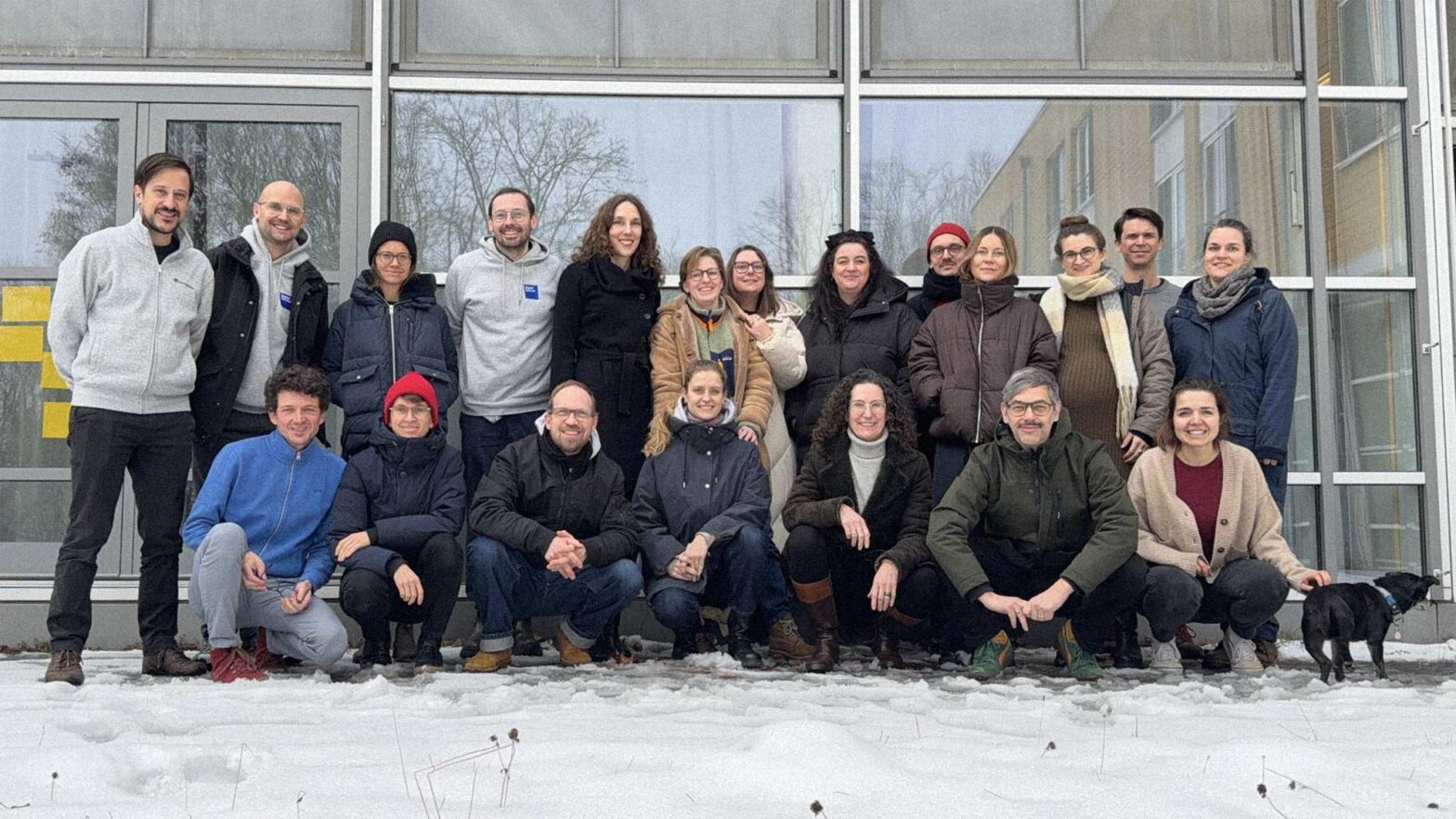
At minus 11 degrees, we went out into the snow. For 2 days, our grown leadership team kicked off the year outside of Brandenburg’s state capital, Potsdam. Most of the time, we stayed inside the hotel, though.
Planning for change in 2026
2026 will bring further growth for the organisation. That means our structures, processes, and formats also need to evolve to allow scaling. That is why we, as the leadership team, decided to kick off the new year with focussed exchange, without the distractions of meetings and notifications.
Getting into the 2-day exchange, we discussed and synchronised our definition of ‘alignment’, as we use the term all too often but might mean different things. The alignment on ‘alignment’ was useful as we reviewed what is needed to prioritise and execute joint leadership activities over the next 6 months. One sensible hypothesis was: “If we spend more time talking about issues and ideas, we will have an easier time executing than if we jump into initiatives too quickly.”
A focus of our conversation was looking at how our now-established business unit leads and we, as heads of delivery, are working together. As the business units, which we called ‘programmes’ in UK departments, have been firmly established, we need to adapt roles and responsibilities within the leadership circle. In a useful exercise, we looked at things through 3 lenses: economic viability, subject expertise and discipline expertise.
Our project management office (PMO), in tandem with the business unit leads, deals with much of the economic viability. The business unit leads steer on their subject, e.g., ‘digitalisation of law’ or ‘digital transformation instruments‘. The heads of delivery, including product, transformation, engineering, and user-centred design, lead their respective disciplines and related discipline expertise. While the latter is true, subject and discipline expertise are often hard to divide, and the heads of delivery have a stake in the subject, too. I know I have. That is why I am spending significant time with the Service Standard team and the team working on the cross-government brand and design system. So, while the lenses are useful for describing accountability, practical responsibilities may differ a bit.
Other topics we discussed include career paths and frameworks, onboarding for new senior colleagues, and overarching quality assurance. In the coming weeks, we will work on these strands, partially integrated into our day-to-day work and partially in parallel.
Hiring some more user-centred designers
After about 8 weeks, we closed our service design role at the end of the week. We received over 150 applications in that time. That is significantly less than for UX/UI design and communication design roles before. It is still a terrific number, and we received various outstanding applications.
I interviewed 2 more candidates this week and will continue speaking to more people next week. As projects progress, we might end up hiring up to 4 or 5 service designers from that round, well above the previously anticipated number. The quality of this job campaign allows that, which is excellent.
There are quite a few applications from aspirational service designers. Many applicants are currently working as UX designers or have a similar label. Actual service design roles in Germany are rarer than in the UK or Finland, according to my observations. Given it’s 2026, 15 years since I started Berlin’s Service Design Drinks meetup, I find that a bit puzzling. People expressed their excitement on LinkedIn, too, remarking that they thought service design no longer exists. In the public sector, it’s more needed than ever, I’d argue.
Depending on the capacity of the talent acquisition team, we might open a content designer role by the end of January. We see significant demand in several areas, including Service Standard and the new Policy Excellence Centre. Both are content- and information-heavy offerings, where clear communication and content for public servants are essential. In the meantime, we will try to work with freelance content designers. I hope we’ll find some good ones – but I learned that Germany is not the UK, and content designers are rare.
At the same time, various other organisations opened user-centred design roles. Again, they are sprinkled all across the country. So, I was able to update my little job board.
Writing and publishing more
Last year, I managed to publish 6 texts. My goal was 7. I wrote articles, blog posts, and an op-ed. But it was inconsistent. I got 3 blog posts published only in November and December, rushing towards my target.
Some texts take time. Others go dormant entirely. Then, some have a powerful dynamic and are out within a week.
My 2026 goal is 7 publications again. I don’t dare to aim for more, not yet, at least. I am currently working on 3 pieces. Torsten and I had a drafting session for a long-overdue content design post on Wednesday. It’s been on my list since 2024. We want to give an overview of how content designers work at services, why it matters, and what the difference is. Such blog post will be handy when we open a content design role again.
Together with unit lead Anna, I started sketching a blog post about our policy and service design efforts. We will discuss why standards aren’t enough and why they need corresponding community and competency building. I hope to spend more time with it on Friday.
Later in the first quarter, Bene, Stephanie and I are aiming to write about open roadmaps and routemaps and why such an working-in-the-open approach for public services and public infrastructure is not just an add-on, but a necessisity.
In another session, I met with principal user researcher Sonja to work on a draft structure for a cross-government research and recommendation paper on common components. As part of our NExT community work, we have had some realisations over the past months that we would like to gather, conclude, and publish. Fittingly, NExT has a workshop mode that has produced a few white papers in the past. We plan to follow that example.
What’s next
On Tuesday and Wednesday, I will help facilitate a workshop on service quality in the ministry. We’ll have participants from across the country working with us on this Service Standard-adjacent work stream. I am very much looking forward to that exchange.
On Thursday, I will participate in the user research half-day onsite. The user research team is bigger than ever, with 8 people.
In the afternoon, Kara and I have a check-in with our colleagues at the EU Policy Lab about our April activities linked to the PolyFutures event.