
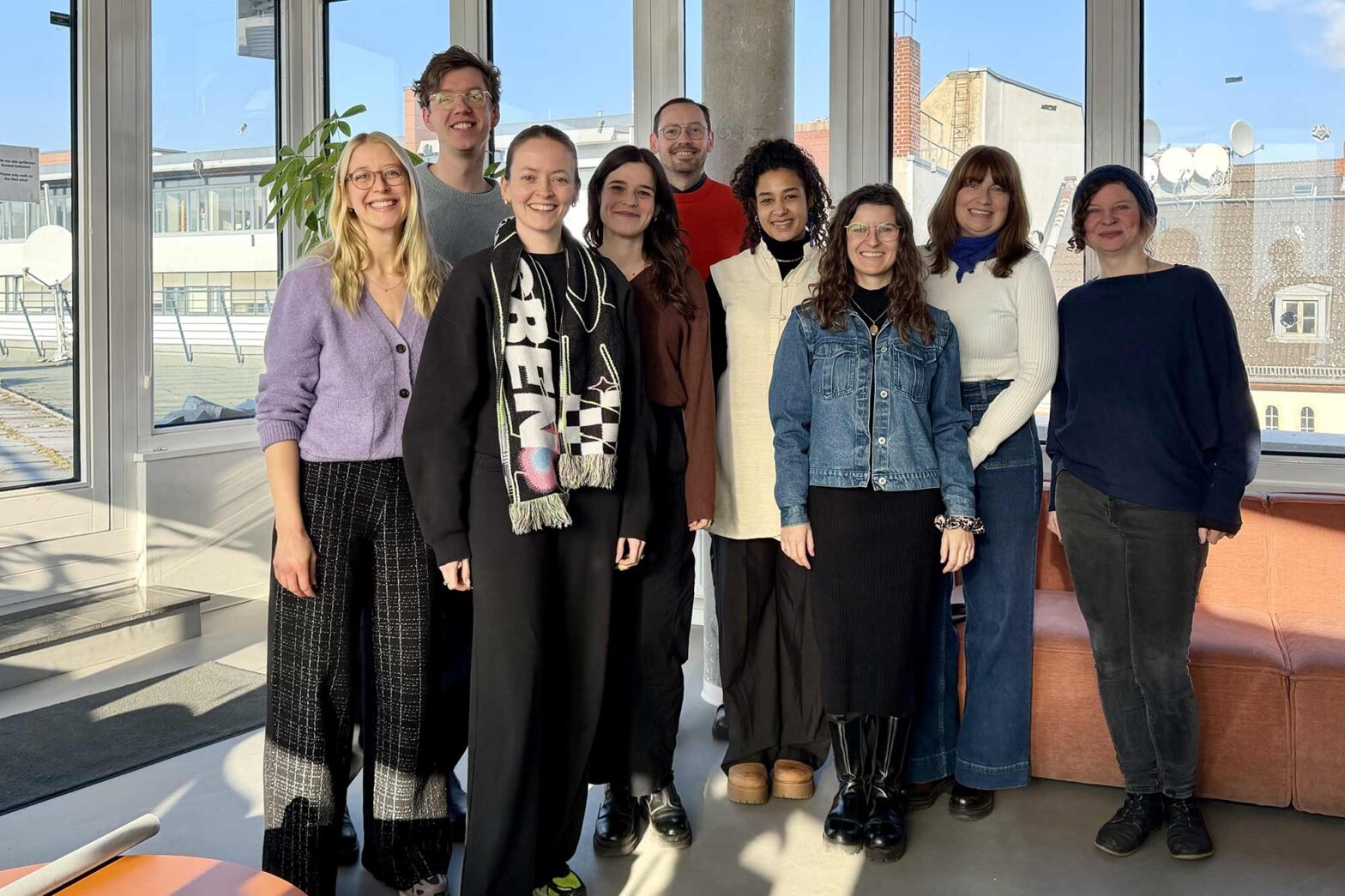
8 user researchers are now in our discipline. We are bigger and better equipped than ever to conduct thorough research, with a strong culture and a robust structural setup.
In the past 12 months, our user research sub-discipline grew by another 33%, as Zoé joined us in mid-March and Elena in early January. 2 more colleagues will grow the team in the coming months.
Taking time with the user researchers to look back and ahead
Like in January 2025, principal user researcher Sonja, who is leading the sub-discipline, organised a half-day onsite. My contribution looked different this time around. I managed to be there for almost 3 of the 4.5 hours. Last year, I could only dial in and deliver a contextualising input, but not be there in person. Then, I shared 8 themes for the user research sub-discipline, which we picked up.
Sonja put the goal of this week’s gathering as follows:
We want to develop further as a sub-discipline, better understand our role, and define topics and responsibilities for 2026.“
Our agenda for the morning was well-structured:
- Sharing our strength with each other – via Clifton Strength profiles
- Recapping 2025 activities
- Setting themes for 2026
- Discussing user researcher roles on projects
For the strength mapping, we used a 2-by-2 matrix on a whiteboard. Everyone shared their strength after taking tests, which we felt comfortable sharing. After having everyone plot themselves on the matrix, we saw a healthy mix of ‘executing’, ‘influencing’, ‘strategising’, and ‘relationship-building’. Some of us have more pronounced strengths – according to their tests – in executing, others in relationship building and strategising. What’s a little more empty is the influencing quadrant.
In interviews, I ask each candidate how they have dealt with a situation in which a stakeholder needed an explanation of a user-centred approach or convincing someone of a particular method of working. While this is important, we might need to do it less frequently due to our culture, contracts, and setup. That was an in-situ reflection on Thursday at least. If the case, I am glad about it as it frees time for other value-creating activities.
Sonja shared the latest user research survey results. It’s a survey we share with colleagues from other disciplines and across teams once a year. The main question the survey asks is: “How satisfied are you overall with user research activities at DigitalService?” Participants answer via a 5-point Likert scale. The 2025 mean is 4.4, which I think is pretty great.
This score and most other aspects we queried have been growing steadily since we established user research as its own sub-discipline in the summer of 2023. The 2 areas that made progress but still have the most room for improvement are a) minimising efforts to kick off new research through standardisation, and b) including users with access needs into our research by default. For the latter, we still lack the network, structures and routine to do it indepently. That is why we rely on external partners, which makes it more effort in procurement, leading to a lower frequency of testing rounds with disabled people and people with access needs. We continue working to change that and increase our internal capability.
Building on the development areas from last year, we reviewed our 2025 activities and plotted new ones for 2026. The unchanged development areas for user research are: Knowledge management, processes and standards, inclusive research, communication, and the role of user research. In silent-writing fashion, we collected new activities for 2026. We mapped the activities against these areas and also found some that didn’t match.
Some of my 2026 activity additions included:
- Sharing user research findings and data with radical openness
- Bringing a user research lens in far before new work starts
- Adding dedicated user research capacity to our policy design task force work
- Creating more user research guidance for the Service Standard’s handbook section
- Taking a broader end-to-end view of services
As we moved from a democratised user research approach, due to having very few user researchers early on, to an embedded model, we are now aiming for an increasingly strategic partnership model. That means moving user research further upstream and earlier – getting involved in more policy work, and shaping work before it is defined.
I am pleased with how the user research sub-discipline has developed under Sonja’s leadership. A blog post from June 2025 shared the progress made in the first 2 years. For later this quarter, a blog post on the growth and development of the entire user-centred design discipline is due.
Workshopping Service Standard extensions
Our Service Standard work continues with an active workshop approach and in a proper co-creation mode. It’s been over 5 years, still in the UK then, when I wrote about taking a community-led approach to the Service Standard. All of it remains valid today and finds a more refined application now. In 2020, when I wrote about it, we could only meet online. In early 2026, we can meet again in person when the need arises to shape standards and guidance.
To extend the Service Standard, we gathered over 30 public servants from federal, state and municipal levels for 2 days this week. Taking over the ground floor’s open space at the Federal Ministry for Digitalisation and State Modernisation, we split into 4 groups to answer the question: “What makes a good government service from a user’s perspective?” So far, the Service Standard in Germany isn’t answering that. It defines how teams should work. But it does not tell what the result should feel like.
In the 2 days, we tried to create a space for mutual exchange, learn from each other’s practice and develop a draft of service quality criteria. As part of that, we also reviewed international examples of similar service quality criteria. I hosted 1 of the 4 groups throughout the days and enjoyed my facilitation part.
As the workshop lasted 2 days, we had time for dinner and a more in-depth exchange. Building on our network engagement for the Service Standard rewrite in 2024/2025, our Public Service Lab events and NExT community gatherings, we were able to activate engaged colleagues from all across the country, travelling from as far as Bonn, Cologne, Freiburg, Hamburg, and Munich to participate in person.
Following the workshop, colleagues from Hamburg, Mönchengladbach, and Wittenberg shared their positive experiences on social media. Knowing that local government budgets are stretched and that teams are often overworked, I was particularly grateful for their arrangements and in-person participation. We hope they will return for another workshop in a few weeks, after we have had time to process their feedback and further inputs.
As part of our ongoing Service Standard research work, we spoke to our colleagues in the government of Cyprus about their work. I wanted to talk to them for a long time and chased them a little bit. They work extensively in the open and publish plenty of content online – from reports and frameworks to tools and blog posts.
We wanted to learn as much as possible about their latest developments in procurement and assurance. I wanted to hear how they are vetting the companies that made it onto their Service Standard-compliant procurement framework, and how they are assessing the suppliers’ capabilities and capacity. I was eager to understand how they handle their verified seal and ensure Service Standard compliance throughout development.
We ran over time, had plenty of questions left at the end, and were very much in awe of how they have iterated on their approaches since the initial setup, with support from GDS. I hope to hear from them in another international call on applying standards later this year.
What’s next
Next week, we will have a 2026 roadmapping session for the Service Standard on Thursdays. Already on Tuesday, I will talk to a group of some 15 state and municipality representatives about the Service Standard, joining an event hosted by a Bavarian public institution working across organisational boundaries.
I also have to write more, as 2 posts should be ready by early February. One is our overdue content design post, which I want to use to advertise a new permanent role. The second post is a reflection on why capability-building is essential to successfully establishing standards. Anna and I want to write up our combined reflections from 3 years of policy design around the digital-ready check and the Service Standard. While these are distinct work streams, they have lots in common. We hope to have a public discussion about these topics.