
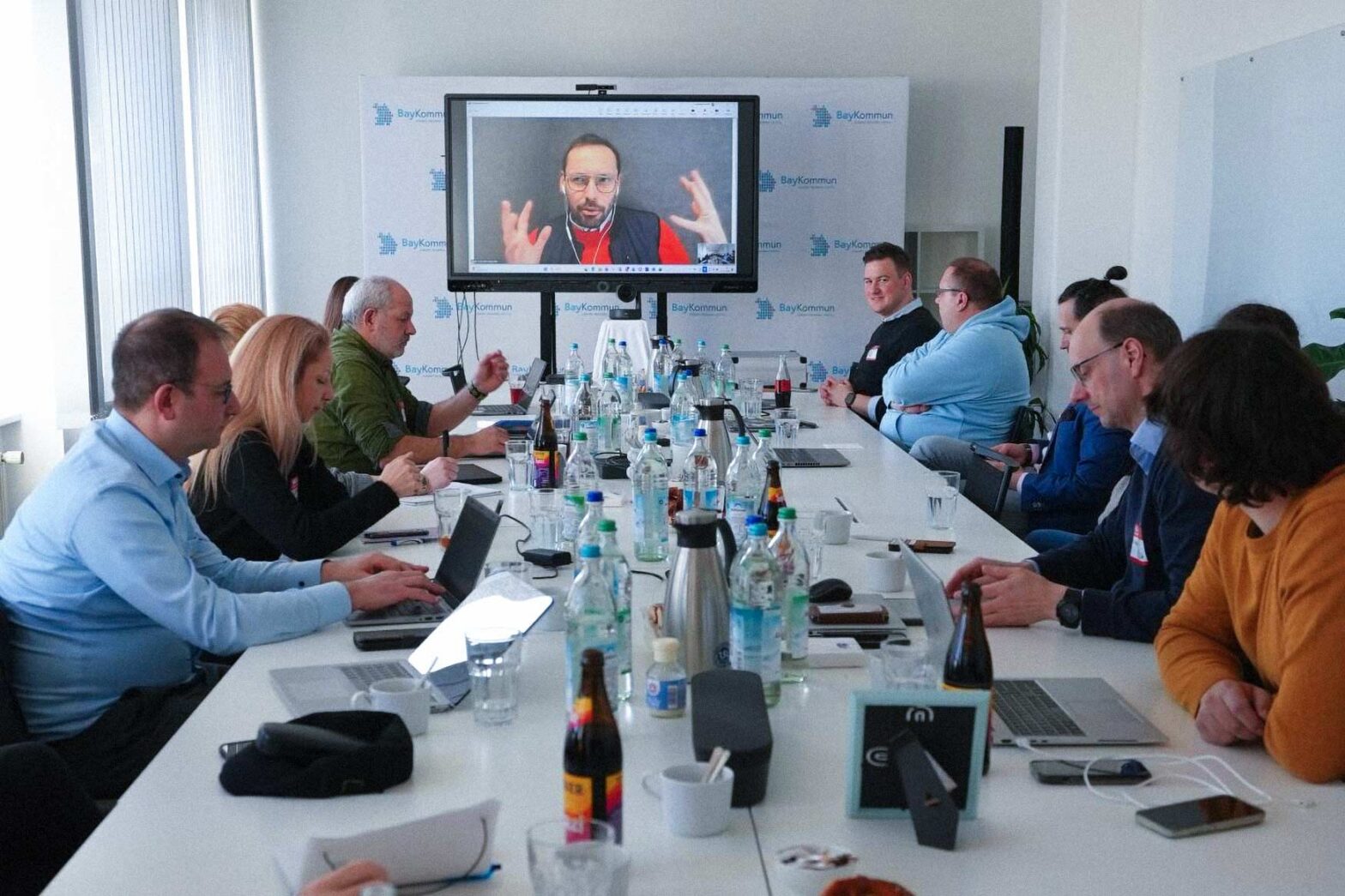
“What can the Service Standard do for us?”, representatives of several states and larger municipalities from across the country wanted to know this week. I tried to answer – with gesticulating hands.
Taking even more Service Standard
Looking at standards from various angles, the representatives asked our Service Standard team to provide input to an in-person meeting they had in Bavaria this week. They are supporting prioritised service roll-out work streams linking all levels of government. I did the talk as other team members ran a workshop at the ‘State in the future’ barcamp. Conveniently, I was able to do it remotely. As per their request, I provided an overview but also covered it from their angles of interest:
- Service Standard as a legal and operational standard
- Service Standard as a financial standard
- Service Standard as an organisational standard
- Service Standard as a technical standard
- Service Standard as a communicative standard
I usually take a broader view, but it was helpful to look at it from these individual lenses:
The German Service Standard is a ‘legal and operational standard’ since the online access standards regulation came into effect in October 2025. Given the deadlines it sets, it needs to be operationalised and implemented now to ensure new services are compliant when launched in early 2028.
Various levels of government are working to make it a ‘financial standard‘ of some kind, tying it to digital budgets and making it mandatory through additional spend control mechanisms and procurement frameworks.
With the roles and skills the Service Standard names and the ways of working it describes, it should at least inform some ‘organisational standard’.
The Service Standard covers technical aspects in various of its criteria, albeit not making it per se a ‘technical standard’ in itself. In the coming months, we aim to align it more closely with the federal IT architecture guidelines.
Lastly, I never thought too much about the Service Standard as a ‘communicative standard’. But our exchange with our colleagues in the Cypriot government last week led us to discuss their ‘Verified Seal’. Excellent services that have met the Service Standard get it and carry it in their footer. By clicking the seal, users can learn about the service’s quality – if they choose to. In addition, the peer review formats and resulting reports can be powerful communication artefacts, too, of course.
While remote setups can be tricky for engagement, I was delighted to spot Adrian in the room. He is heading up the digital agency for Brandenburg and has been a vocal supporter of the Service Standard for a while. I referenced some of the work he and his team are doing to start a conversation in the room.
On Monday afternoon, I had the pleasure of talking to Ben, who’s managing the UK Service Standard and Service Manual. He is continuing the work we started in 2020 and has rebuilt a pretty capable team over there. It’s been some time since we last talked. 3 members of our Service Standard team in Germany were eager to join. Our contexts are different. One team is trying to integrate everything, the other is looking at slicing things. One maintains a vast amount of content, while the other is racing to establish the baseline.
While our contexts differ, the offerings are comparable. Ben highlighted that everything is part of a larger, interconnected set of service offerings, not just a few products. That aligns with our view and is why we are currently hiring a service designer to join the team. Also, we all have to constantly re-establish and rebuild senior stakeholder support. It’s a task that never ends.
Workshopping 2026 for teams and disciplines
Dedicating plenty of time to our Service Standard team this week, we spent 2.5 hours shaping our 2026 roadmap. We have a fresh agreement for the work that outlines work in 6 areas, but there is much to spell out, prioritise and move around. So jointly, we did that.
As overarching unit lead, Anna shared her latest thoughts in a 5-minute input, which focused much on means for capability-building across the public sector to implement standards effectively. For the following 5 minutes, I was asked to share some things that worked well in the UK before.
I wrote a short presentation that builds up to an overview graphic of the intertwined standards for services, technology and design. It also includes the necessary sticks and carrots to make the standards have an impact.
Both inputs helped us accelerate discussions in the following hours. We aren’t done yet; we will continue our roadmapping session next week.
As there was time and space in the design & user research discipline weekly meeting, I shared my hopes for 2026. I wanted to do that last year, but I never found the time, and it wasn’t until December that I shared and reviewed my hopes for 2025. Charlotte facilitated this week’s session, and while talking, some attending colleagues started mapping emojis to their hopes, expressing how they resonated with them or how they felt about them.
On Friday morning, our little discipline leadership team dedicated 3.5 hours to reviewing how our growing discipline is doing and what it needs most in 2026. Principals Charlotte and Sonja, people partner Annemie, and I got together to check in, run a retro, review the high-level organisational objectives for 2026, and link activities we see a need for in our discipline.
We will work out the further details in the coming days, share the work across the organisation and then also blog about it.
Blogging to defend democracy
Trust in government and state institutions is low – wherever you look. Yet government isn’t doing the obvious thing to address it: opening up.
Instead, the Mayor of Berlin just declared: “We must put an end to excessive transparency. […] We need a review of transparency, freedom of information and open data solutions.”
But if people don’t trust you, you might not want to lock down; you might want to open up. To share, to start a dialogue, and to invite active participation. How else can you regain trust?
It’s been around 15 years since the UK Government began following a then-radical ‘Working in the open’ approach. “Making things open, making things better”, Mike Bracken said, in a blog post. And the phrase became Government Design Principle #10. That led to blogging, putting code on GitHub, and publishing most content under a Creative Commons Attribution license. It was a dramatic change in the behaviour of government departments.
But while UK Government bodies published more than 8,500 blog posts since then, things have gotten spotty. Some blogs went dormant, some prolific civil servants stopped writing, and some people went elsewhere. If even deputy directors take their content to Medium or LinkedIn because getting things out got too hard, you know some things snapped back.
Whether in Germany or the UK, trust in government hovers around 35% to 37%, depending on the survey. With the rise of the extreme far-right and the dip in confidence in democratic institutions, working in the open is no longer optional. It becomes a necessity. Working openly turns into democratic defence. (But the occasional self-promoting LinkedIn post isn’t that.)
Some people are doing exceptional work. There are great weeknoters here; others write on their own blogs. People like Andrew Knight keep collecting policy design stories internationally and probably wrangle quite a bit with comms colleagues. I deeply respect such persistence.
Personally, in 2025, working openly meant publishing 52 weeknotes – one each week. They contain 58,004 words of work reports and public accountability. And as wrong as it sounds, I co-authored 40% of the posts published on the UK ‘Design in Government’ blog.
At Digital Service, we published 29 blog posts last year. I co-authored 2 of the 6 user-centred design ones. Otherwise, blogging in the German public sector remains a rarity. Notable exceptions are DigitalAgentur Brandenburg, health agency gematik, and innovation agency SPRIND. They maintain blogs, but thousands of public organisations from federal to state to local level do not. Yet we need insights into the actual work and ways of working – for openness to the public and for peer-learning across the sector.
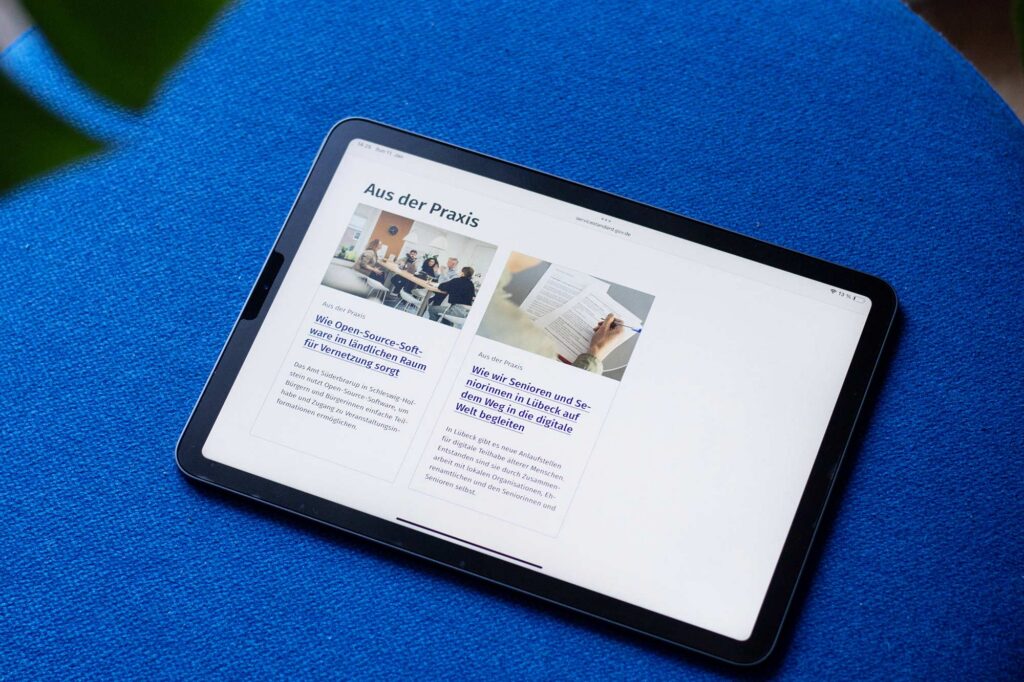
So, in the absence of a cross-government blogging platform in Germany, we opened and actively grow ‘in practice’ as part of the Service Standard’s handbook. It’s a space for teams from all levels of government to share stories about service design and development. I am eager to see people from across the sector to make use of it.
In our monthly cross-government user research exchange call, content designer Linn invited over a dozen public servants from 9 organisations to help with the editorial part of the blogging efforts. We are looking for people to scout stories, ensure quality, and be ambassadors for blogging across different parts of the sector and the country.
What’s next
I need to be serious about writing 2 blog posts.
We now have a deadline for the content design post: 12 February. That is the date for the first-ever content design meetup in Berlin. Some folks from Miro and Babbel decided to set it up, and I am excited about it. My colleague Torsten asked if they consider integrating a job board, and they might. So, we aim to have our new permanent content design job opening and a corresponding blog post ready by then. It will be a little race, but it’s doable.
The other post is linked to Anna’s input from the Service Standard roadmapping session this week. It’s on capability building to make standards stick. We are co-authoring it.
We might also make some hiring decisions.