
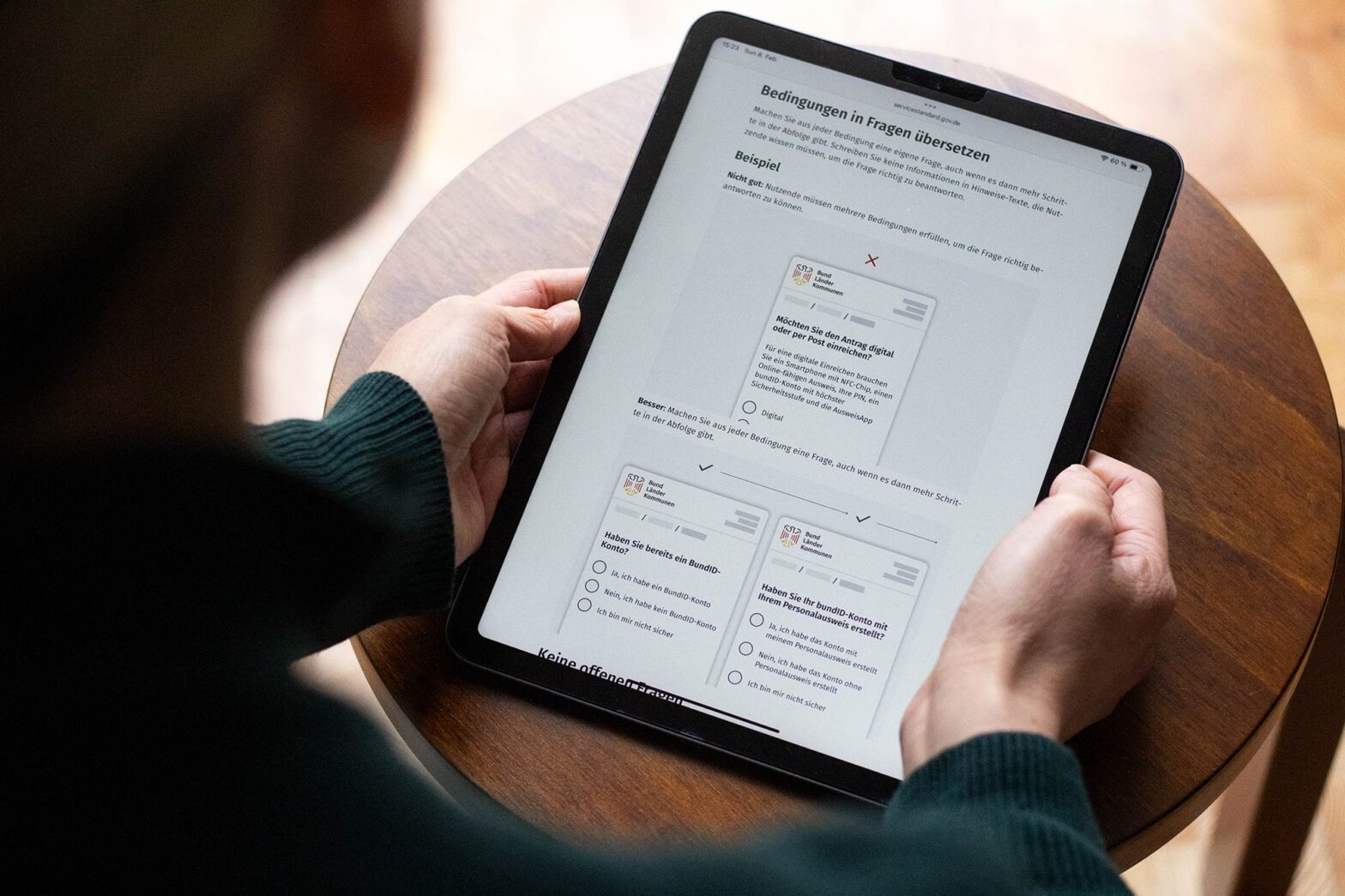
Government doesn’t know what good looks like. This is what it seems, at least. Every form is different. There is no consistency. And over 160 portals exist on the federal level alone.
That’s why we are going all in with guidance on what good practice looks like.
Extending and improving servicestandard.gov.de
Things take a while. But now, several new pieces of guidance have gone live and expanded the handbook section of the Service Standard. 3 of them tell readers how to design government forms that work for the users and the providers; forms that are easier to understand and result in lower error rates.
My colleague Paul started working on them in late autumn when coming off a project and having some ‘bench time’. He dedicated his time and expertise to the best possible task: creating guidance that summarises what he and his colleagues have learned over the past 3 years working on justice forms and transactional services in other areas.
The longest of the 3 guidance pieces is on ‘designing forms with clear questions’. It comes with plenty of real-world examples from our work across several service areas and 5 years of Digital Service.
Together, designer Paul and engineer Julian gave a talk at FormFest 2024 that summarised some of their learnings reworking bad forms. Some of that knowledge has informed the guidance.
Giving talks is great for informing and inspiring people, but creating authoritative guidance is long-lasting and potentially transformative. We have seen that with GOV.UK Service Manual content. It has informed how digital specialists talk and work for over a decade now.
Still, my stretch goal is to create German-language guidance that serves not just the public sector but far beyond; guidance that is highly ranked in search engines and reaches specialists across industries. Let’s see what it takes to get there.
This week, the Service Standard team was lucky as new starting UX designer Marius didn’t immediately start with the work intended for him. Instead, he was able to review servicestandard.gov.de. Marius is the first designer in our discipline operating with a Linux machine. That didn’t hinder him from quickly becoming familiar with the Service Standard repository on OpenCode and reviewing issues and improvements in GitLab. Everyone on the team is happy that he will be around for a few more days to look at interaction design and navigation improvements.
In other news, the Federal Ministry for Digitalisation and Government Modernisation published an update on its work on service quality criteria. I was pleased to see that. The text frames the work as an extension of the Service Standard and DIN SPEC 66336. It also outlines the consultation process, which involves direct citizen participation through workshops. These will take place in 3 German cities at the end of the month, in Berlin, Cologne, and Erfurt. I plan to participate in some of them if my time allows.
On Thursday, we shared the results from workshop 2 weeks ago with the ministerial partners, with the citizen participation colleagues from Nexus Institut also present. Once all input – from citizens and civil servants – is consolidated, the service quality criteria will be published on the Service Standard website. This is planned for late March.
Wrapping up and kicking off hiring
Earlier this week, I finished interviewing service designers. Overall, we received just over 150 applications. They should lead to up to 3 or 4 hirings.
While I am done with my section of the interview process, we only now started wrapping up the last interview rounds. At Digital Service, we usually have 4 stages. My talent acquisition colleague Denise recently blogged about it. After Denise conducts an initial screening, I have a 30-minute conversation. I usually reserve 45 minutes for it to give the exchange a little more space. I often make use of it.
The 2 extended interviews in stages 3 and 4 go deeper. The user-centred design deep dive is usually 90 minutes. Other senior designers lead it. The final call is a collaboration interview of about 60 minutes and is often led by colleagues from the engineering, product and transformation disciplines when we are hiring. In return, designers participate in the collaboration interviews in their hiring rounds. The collaboration interview is to understand how well the person can work in and with multidisciplinary teams in our environment. Before, the user-centred design deep dive helps determine a person’s capabilities, expertise, and experience.
As we start speaking to people from the moment they apply, the first person in the cohort begins on 1 April. We should complete all service design hiring by next week. That includes making the last offers.
One late afternoon this week, a young service design graduate spoke to me after booking time via my Mega Mentor calendar link. They have lived and studied in different European and Asian cities. Now, they are looking for junior service design roles. These aren’t easy to find, I agreed and explained what I believe it takes for a responsible organisation to create junior roles. We at Digital Service are surely at the stage, but so far, we have been rather working with students who then stayed and joined us as permanent staff at an entry level. We should review this and look for junior-level designers later in the year.
The next role we are preparing is content design. Due to demand on the talent acquisition team, we might only open the content designer role in a few weeks. In the meantime, we have been actively reaching out to freelance content designers who could help us sooner than summer and across multiple projects. That is needed as hiring people takes between 4 and 6 months. The permanent content design position is in the Service Standard team. The freelance content designer will be required there and elsewhere, too. They will have the chance to work on some great and very different pieces of work.
I hope we will still have a freelance person start in the second half of February. That would mean we could create more vital Service Standard guidance.
What’s next
Next week, we will plan how to put together a white paper as part of a NExT Werkstatt (German for workshop). The paper is supposed to summarise findings on digital identity and gather research insights collected across government.
I will also participate in a world café session with ministerial colleagues involved in federal government design and branding.