
How much are you working with citizens and residents?
And how long has your longest interaction been?
So far, most research-related encounters have been less than 90 minutes. That’s only when an interview or a combined usability test runs over. Most often, it’s much less time.
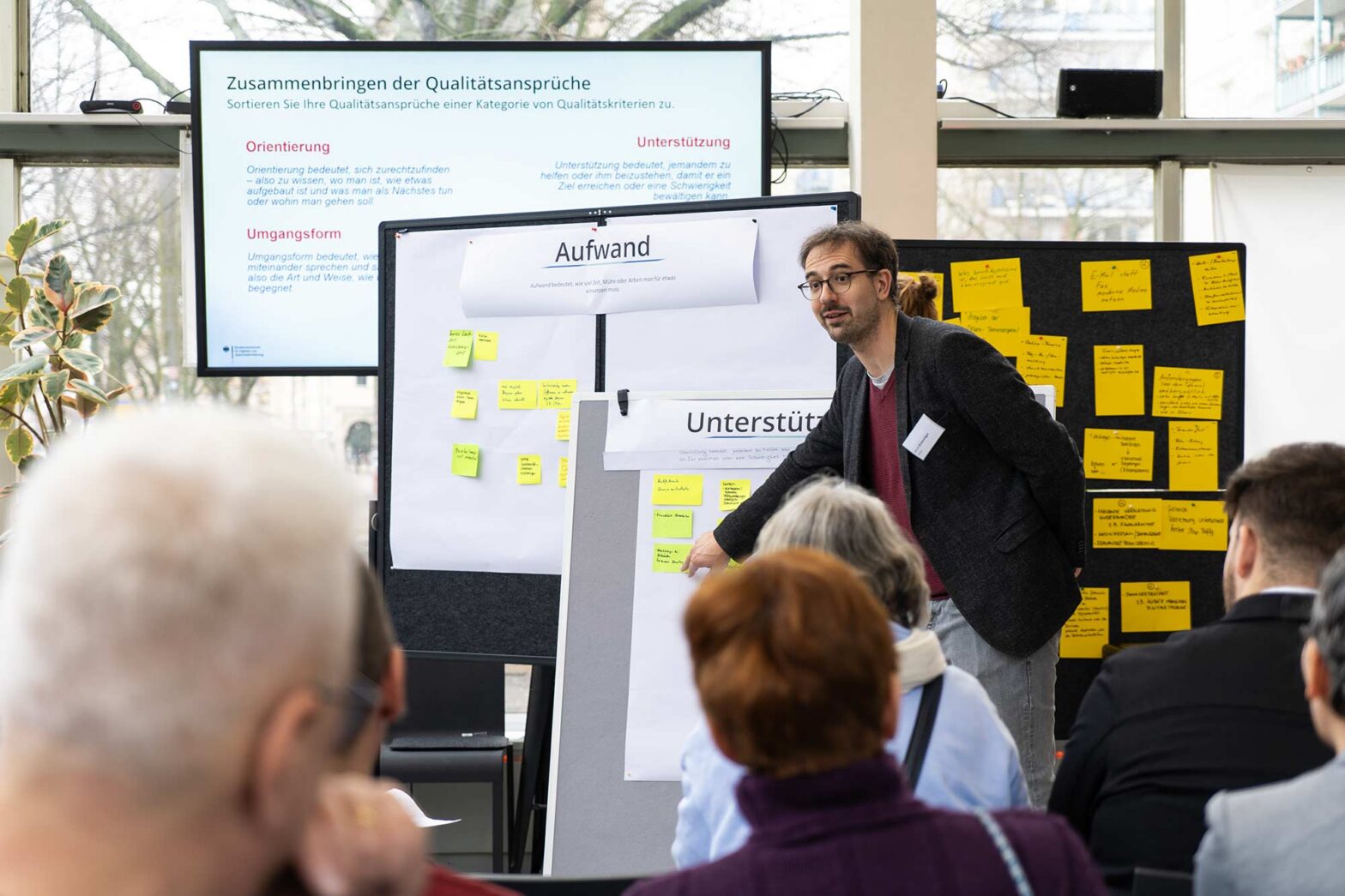
This weekend, I participated in something quite different.
Participating in a citizen workshop on service quality
Saturday, from morning until afternoon, I attended a workshop on service quality criteria. About 30 citizens and residents participated. They came from 6 different federal states and were selected from among around 140 people who expressed interest.
Before, over 6,000 people living across Germany had received a written letter from the Minister for Digital, inviting them to shape service quality criteria for government services. With rich experience in citizen participation workshops and running citizen assemblies, Nexus Institut facilitated the day. Stefan and I assisted a little.
The workshop moved from a very open discussion of experiences with government and public services to mapping what good and bad look like, and eventually to reviewing what civil servants had sketched as criteria back in January. There were short inputs in between. The participants used the Q&A time to learn more about the format and the challenges of government transformation. The group was curious and, overall, fairly diverse in terms of age, background, social status, and ethnicity.
During the lunch break, Stefan and I recorded 4 short interviews with vocal participants. In about 2 to 3 minutes each, they shared their motivations, observations and hopes for the day.
Next week, there will be 2 more workshops. They will run in parallel with the same structure in Cologne and Erfurt. Afterwards, we will synthesise the outputs and bring them together with the January material from the civil servants. In mid-March, we will hold the final workshop with the latter group at the ministry in West Berlin. We then plan to publish the finalised service criteria by the end of the quarter.
Spending more time on hiring and staffing
On Thursday, we opened 2 new roles. We are looking for a mid-level content designer and a working-student user research person to support us operationally.
It’s been about 18 months since we last opened content design roles. Our content design team currently consists of 3 content designers. They are permanently part of multidisciplinary teams. But regularly, other teams ask for their help and advice. To a certain degree, that is okay. But we don’t want one person to get immersed in too many complex service areas at the same time. The results wouldn’t be as good.
The new content design role is to support Linn on the Service Standard and the many pieces of guidance we want to produce throughout the year. In addition, we need another content designer to help other teams. For those tasks, we are trying to bring in a freelancer who can more easily jump between packages of work.
Making further progress on servicestandard.gov.de
Last week’s delivery successes on servicestandard.gov.de continued. Designer Marius and engineer Ronja just kept shipping.
The guidance template is reworked. The spacing for paragraphs is bigger. The step numbers are smaller; the connecting lines are thinner. The underlying grid has also changed. You can see the changes live on the page explaining our peer reviews.
There is a problem with font flashing. Loading the font takes a little too long. So far, users have seen a serif typeface for a moment before it is replaced by ‘Fira Sans’. We need to upgrade to a newer version of the KERN Design System’s frontend library, but we have a dependency. For now, the font change is smaller because sans-serif is the fallback.
Now, there is also a ‘404 page not found’ page that is trying to be as helpful as possible.
Marius also designed a card style for the standard points on the landing page, which we haven’t opted for yet.
The biggest change was the implementation of the dark mode. Building on last week’s accessibility fixes for the high-contrast mode, Marius and Ronja had rather little to do. Both modes load inversed logos in the header and footer. Fonts are rendered in a calm light blue.
I like the subtlety of the implementation. Different hues of dark blue are used for the government topline and the title area below.
I also checked with Birga, our freelance service designer, who has been helping us with the service quality criteria work. While the citizen workshops are running, she has some downtime. That allows her to support the ongoing Service Standard workstream. One of the team’s priorities is to build a self-check for teams to see where they are with meeting the Service Standard, the DIN SPEC 66336, and its 70-ish individual criteria. We already list the self-check in the what’s-to-come section of our open roadmap.
There was previously a simpler self-check launched around 2021, which was decommissioned sometime last year. We hear from users of the Service Standard that there is value in accessing the content interactively and in becoming familiar with the standard in a less text-heavy format. So, we want to respond to that expressed need. Tito created a quick draft of a revised form-based self-check sometime in the summer. We have learned a few more things since then – and haven’t tested that coded sketch yet. There is some work to do. I like to see the new self-check go live still this quarter. I provided context, user insights and ideas to Birga. She is going to run with those.
What’s next
Torsten and I finished our blog post on content design. It became a rather lengthy text again. We are about to hit 1,900 words in the end. Hopefully, our comms colleagues can trim it a bit before publishing it next week. I took some decent pictures for the post, which I will add to the Flickr account we set up.
On Monday, Sonja and I will get together to structure our whitepaper work on common identity components.
In the second half of the week, I hope to return to the article on building capabilities for people to meet standards for policy and service design. It has been lingering since January. Now, there should be some headspace for it again.
One comment
Comments are closed.