
Some 3 weeks to go, Tom says.
Tom must know, as he is leading our redesign efforts for service.justiz.de.
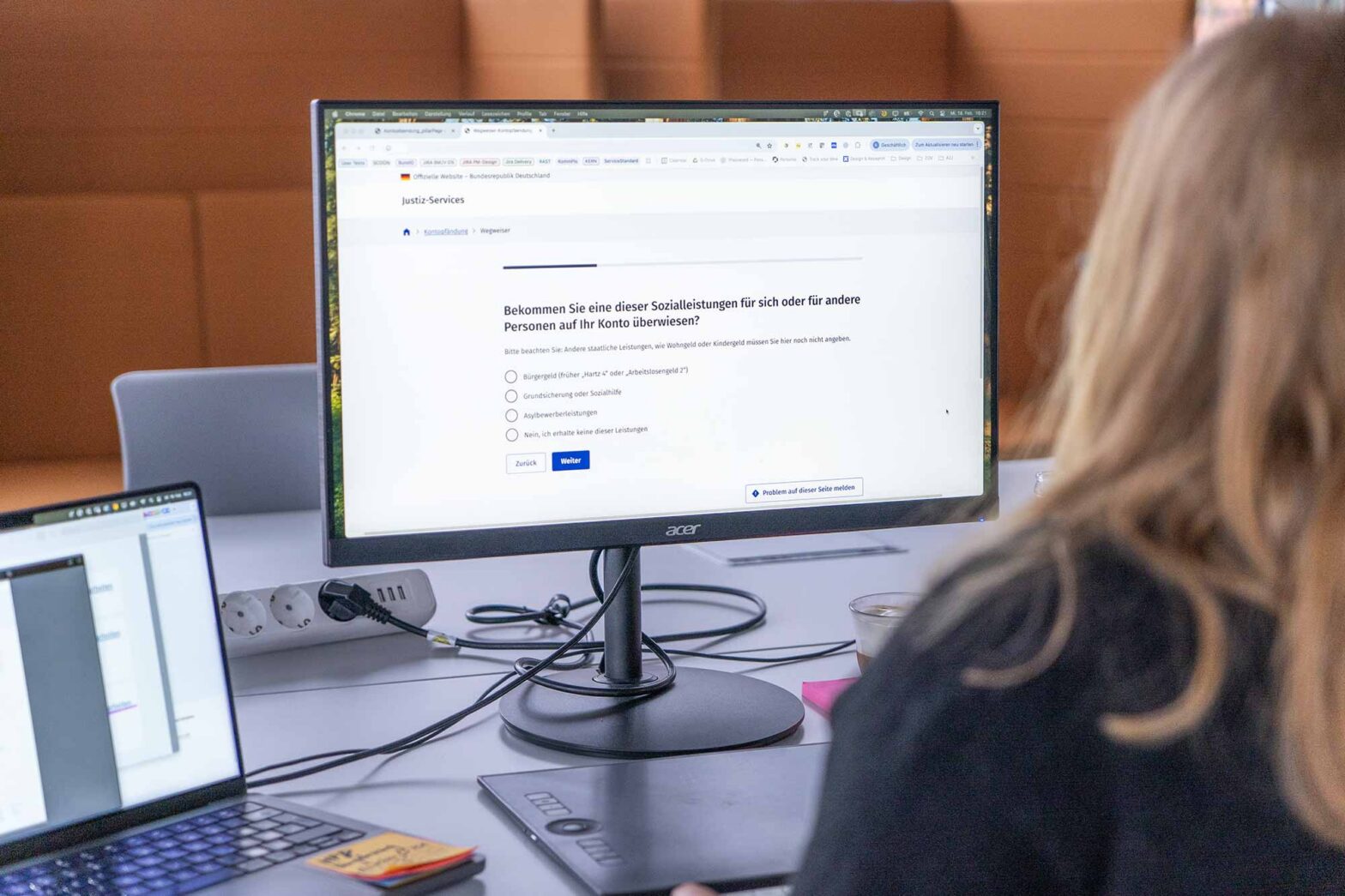
As I couldn’t wait for the redesign to be ready, I asked for a preview I could share publicly. Alisa and Tom provided various screens for me to photograph, as our blog post on content design was due.
The redesign won’t be huge, but it will still be significant. It’s about switching from a homegrown branch of the Federal government style guide to the cross-government style guide and design system. By switching, we will link up to what we are already doing with servicestandard.gov.de. More on this in a few weeks.
I wanted to ensure the blog post is visually future-proof and doesn’t show a justice service that will look outdated by April.
I’ve shared the content design blog post with anyone who didn’t ask for it. It includes things I wanted to have written down in German for a while. Our new job opening gave a good reason to get it done.
Hiring a content designer
Hiring is hard. Because even in this job market, some profiles are incredibly difficult to find. Content design is one of them. Legal design is another one. In Germany, content design remains a surprisingly rare skillset.
Writing for digital services is handled by product managers, UX designers, or software engineers, because everyone can write, right? It seems that German businesses haven’t yet seen the tremendous value the approach delivers. Content design – and content designers – ensure that the right information is presented in the right amount of detail at the right time in the most suitable format. Content design is about user flows, reading patterns, content formats and types – all continuously tested and iterated. That’s not a responsibility a person can do on the side and then do well.
Earlier this month, the first Berlin Content Design meetup took place. I missed it, but my colleague Torsten joined. He confirmed what we suspected: there were very, very few German-speaking content designers in attendance. The turnout mirrors what we see in job applications. Some people have content experience. And some people have design experience. But almost no applicant comes with both. Or at least not at a C1 Level of German. Some candidates are great with words, while others have made digital products and services.
We are looking for people who have shaped content for user-centred, iterative offerings and who have worked on multidisciplinary teams in agile environments. The difference to other setups and work modes matters because what you make and how you make it are quite different.
Of course, we look at each application with a healthy dose of optimism because we want to find and develop future talent. Yet I am still stunned by how different Berlin is from London. Whether it’s banks or insurance companies, charities or councils, you find content designers everywhere. Former UK colleagues told me there are great technical writers in Germany. They are part of a community that has been developing for decades. If they indeed exist, somehow, we don’t seem to reach or be able to attract them.
Our content design discipline currently has 3 people: Linn, Susanne, and Torsten. Quickly, they have demonstrated to the whole organisation what a difference having a content designer on the team makes. That’s why so many teams are now asking for one. Hence, we want – we need – to grow content design at DigitalService. As some people have noticed, government services are mostly words. We need to get them right.
That’s not it, yet. We have more openings.
In our discipline, we are currently looking for:
- a mid-level content designer
- a working-student user researcher (ops)
- a freelance graphic/comms designer
I started reaching out via LinkedIn, big Slack instances, and direct messages. My related LinkedIn post received 20 reposts and 50 comments, with over 8,500 impressions.
Various people reached out to me, asking for details. I responded as quickly as I could. I will speak with various people in the coming few days to clarify their questions.
Doing admin tasks
There are way more administrative tasks in my role and week than I ever reveal here.
This week, I handled the paperwork required to bring in a freelance content designer. As it took us a little while to open the permanent role and as there is more demand from teams than even the permanent person can handle, this is needed. With everything cleared and all documents and sign-offs in place, I hope the freelancer can start next week.
Throughout the week, I also sorted out unused Figma accounts. Co-discipline head Christian and I set up a new routine to frequently check account use. We know teams have much on their hands. At the same time, the IT team cannot judge which accounts are needed and which are not. So we now have reminders in place to review all recently unused licences and check in with the users.
Making sure people can work well and the organisation uses its budgets responsibly is one of the less shiny but vital tasks I have.
Clarifying our family of user-centred design disciplines
“Who is actually doing all the user-facing research work at your organisation? Do you have specific profiles for such activities?”
This question from a ministerial colleague surprised me a little bit. It provided further evidence that we are not clearly enough articulating how we are set up, what capabilities we have developed and what specialist profiles we have established. It emphasied the importance of an objective we have identified anyway: articulating how our user-centred discipline family is set up – for everyone in the discipline, our organisation, and in partnering ministeries. That matters. Otherwise, we cannot do our work well.
We had our second session on the topic. Sonja created a grid for us use to capture what we do in each of our 4 user-centred design disciplines. Sonja already described user research, Charlotte covers UX design, Torsten will do the same for content design, and I handle service design. For now, we might leave legal design out, as it’s less clear how this specialist discipline will continue to grow this year. The 4 of us will do some asynchronous work and reconvene in the coming weeks.
I see different outputs at the end of the work. Among them: an internal lunch-and-learn session for everyone at Digital Service, a short presentation that can be used as a segment for public talks, and a blog post in the second quarter of the year.
What’s next
Next week will be interestingly busy.
On Monday, Sonja and I will run the kick-off for our whitepaper writing club. It will dive into issues with the current digital identity common components. We have assembled a capable group of co-writers and research contributors. I might also stop by the Embassy of Estonia in the evening for some talks on digital.
On Wednesday, we will start analysing and synthesising the results of the 3 citizen workshops on service quality criteria, of which the last 2 took place in Cologne and Erfurt yesterday. I am looking forward to that exercise.
On Thursday, we have some colleagues from Austria joining us. They are interested in how we are set up and wondering what they could replicate there. We are happy to share, of course. I also plan to attend the opening of Google’s new Berlin AI centre, where ministers are expected to join, too.
On Friday, I will help run the second part of our Service Standard workshop with the teams behind the hunting and fishing licence for the State of Brandenburg. We will try to pick things up where we left them in early November.
Also, we have 2 new starters in March. Laura is joining us as a user researcher, and Tanja starts as a UX designer. I will welcome them tomorrow.