
This week, I worked more than 1.5 days hands-on with our service teams.
This rarely happens. But – different from the other heads of discipline – I am supposed to. Or rather, I willingly and purposefully got myself into this situation because I really want to.
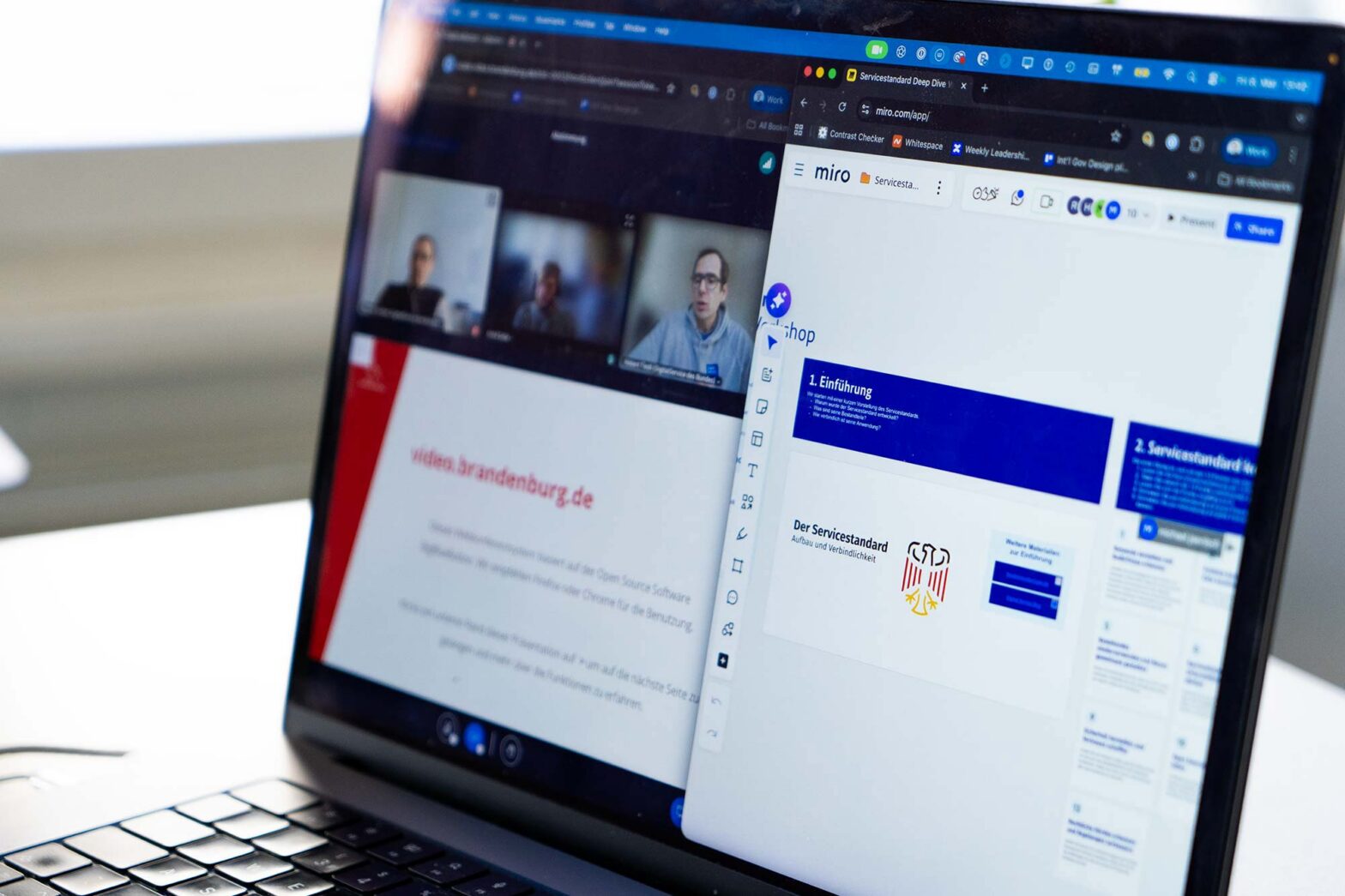
Friday afternoon, I found myself in a 3-hour workshop. It was already the second one with colleagues from the state and local government levels. Back in November, we went to Potsdam to introduce the Service Standard to a group of people jointly responsible for hunting permits and fishing licences.
This time, we continued remotely. It was a mixed group of people with different levels of experience in digital product and service development. While there was a broad general openness to working towards the Service Standard, not everyone thought it was necessary to do the work described in DIN SPEC 66336 for each point.
We are now exploring how we can offer more practical support. Their development phase appears to continue for another 10 months. I will check next week to see if we can offer a couple of days of user research capacity. I believe it can boost their efforts vastly and help us write a case study on how small efforts can lead to good services.
Kicking many new things off
Somehow, this turned into kick-off week.
- Writing a whitepaper
On Monday, we held the first meeting of our cross-government working and writing group, gathering insights on the state of digital identities. There was a good amount of enthusiasm, and we will collect data throughout March. - Testing a Service Standard hotline
Also on Monday, we discussed a proposal to trial a weekday support hotline for people with questions regarding the Service Standard. We debated the framing of the offering, the operating hours, and how we want to test the hypotheses we collected. We plan to launch the hotline later this month. - Producing guidance on asking for feedback in a service
On Tuesday, we started work on a new guidance on gathering feedback throughout a service. It’s for the handbook section of the Service Standard website. Researcher Joshua was as eager as I to create it. Together with content designer Linn, we compiled our thoughts and notes. By next week, we might already be able to test a rough outline with a potential reader from local government, who plans to stop by. It can be motivating to move fast. - Documenting our delivery principles
On the same day, Head of Product Management, Clara and I started outlining a new blog post. Our working title translates to ‘Liberties and constraints – how delivery principles guide our service development’. Almost 2 years after introducing the delivery principles, we are good at sharing them with new starters during onboarding.
We aren’t so good at keeping them for everyone present afterwards. Through the blog post work, we are trying to change that. For that, designer Bianca also reviewed the poster design and made various suggestions for improvement. - Developing a website for the cross-government umbrella brand
I finished a concept paper hours ahead of the meeting with developer Ronja. More than half a year after making a functional draft of a website for the cross-government umbrella brand and design system, we will develop it for real. We decided to use the codebase for servicestandard.gov.de and create a cleaned clone.
We plan to launch the first version of the website by the end of the month. - Scoping a Service Standard self-check tool
On Friday morning, we went through some productive loops. For a while, we promise to offer a self-check tool for Service Standard users. Now, we have the capacity to look into it as a team. UX designer Paul and service designer Birga joined us. The Service Standard team hasn’t seen such design capability in its 1.5 years of existence. While their presence on the team is only temporary, more user-centred designers will join permanently next month. It allows us to start rapidly into a combined discovery-alpha stage, which may include some co-creation sessions with users. - Welcoming more new starters
This week, I got to welcome and later introduce 2 more new starters in the all-hands meeting: designer Tanja and user researcher Laura. They are going to work on the digital-ready check and start a business service, respectively. Their arrival brings the size of our user-centred design discipline to 45 people. We will 3 more new starters in the coming 5 weeks. We might be a group of 50 by summer.
As the saying goes: ‘Stop starting, start finishing’. But you still need to start things in the first place, of course. So, it feels good to get going with several new initiatives, tasks and artefacts.
Talking about artificial intelligence
While it was a dense and busy week, there was a little more to squeeze in.
On Monday evening, I stopped by the Embassy of Estonia for an evening on digital transformation. I missed some of the afternoon talks on digital trust, but had some good exchanges with people from CityLAB Berlin. One project mentioned was prominent later this week, on Thursday. Google opened its AI Centre Berlin, with several officials in attendance and invited to a day of panel discussions, demo tours, and even a party.
I followed a discussion on the future of science in the age of AI. Panellist Alena Buyx made the most memorable point: “You still need to cut – and be able to cut.” She talked about the radical shift in surgery when non-invasive methods suddenly became the norm. People only had to make tiny holes in the skin instead of opening torsos and other body parts, which is better for everyone involved in the procedure. Previously trained surgeons had to retrain while new doctors still had to learn how to cut a person open when it’s suddenly needed – and be routined enough and confident to do so. That analogy resonated with the entire panel and audience in the context of skills, knowledge and experience across industries, disciplines and specialisms in the age of AI.
Also this week, I gave an interview to a PhD researcher at the University of Cambridge who is researching the use of generative AI in service design. I easily filled the 45 minutes we had scheduled forher research interview. I told stories and observations from across our projects and shared some of our latest explorations. The researcher was very satisfied at the end, calling it one of the most insightful conversations she had so far. I am looking forward to reading the results in some months or years.
Returning to our meetup series
In late October, we ran our last public-facing meetup on ‘visualising data’. After a generous 5-month break, we return with a new edition and topic.
We went back and forth, and one of our favourite topics still won’t materialise just yet. So we checked what else is interesting, relevant, and where noteworthy work is happening. We concluded that ‘Remaking the welfare state’ could be something of interest for our attendees. Swiftly, we had 3 talks and assembled an excellent lineup of speakers.
Think tank Agora Digitale Transformation will share its proposals for a user-centred digital welfare state. Our colleagues from CityLAB Berlin will show the work on a vastly improved basic security benefits service. It’s work that is supported and co-financed by Google.org. Two of my colleagues at Digital Service will share our policy discovery work on improving full-day care for children in need.
The description I wrote says:
A welfare state takes responsibility for its people and supports them when in need. When costs are rising, but budgets aren’t, government needs to find efficiency gains to maintain social protection levels. A government-commissioned report recently recommended ways to modernise social and welfare services, making them more people-friendly and less bureaucratic. Meanwhile, small and large projects are underway to make benefits services more fair and easier to navigate, and to make the state overall more equitable.”
Within a day or so, 50 spots were gone.
With a 5-month break from meetups, I felt rusty when designing the poster. I have very few opportunities to train any visual design muscle. But once I got into making, a design from some sketches I made in my notebook materialised fairly quickly.
What’s next
Next week, we’ll wrap up the 5-part workshop series on co-creating service quality criteria. After the January workshop with public servants and 3 citizen workshops in February, we will now conclude the work on interactive refinement. We will have 2 more half-days to do that. Public servants from all parts of the country will travel again to Berlin for that reason.
Before the first workshop day, a colleague from Munich will stop by to discuss integrating feedback components and recording qualitative and quantitative feedback within a service. After this week’s kick-off, I am confident that we will have an outline of the guidance to test with the colleague.
I met with designer Carina this week to plan an interactive session on service design linked to life events. It’s for a gathering of our internal service design community of practice. We are bringing the OECD cards I received in Paris to the table and using them hands-on.
I have until Monday afternoon to submit for this year’s Service Design in Government conference session call in Edinburgh. Currently, I have 3 drafts:
- Policy and service design as one – how Germany skips the silos
- All views included: Co-designing Germany’s
- What we gain when we leave – how movement in and across the public sector is good for us all
Let’s see what I finish over the weekend and then submit on Monday.