
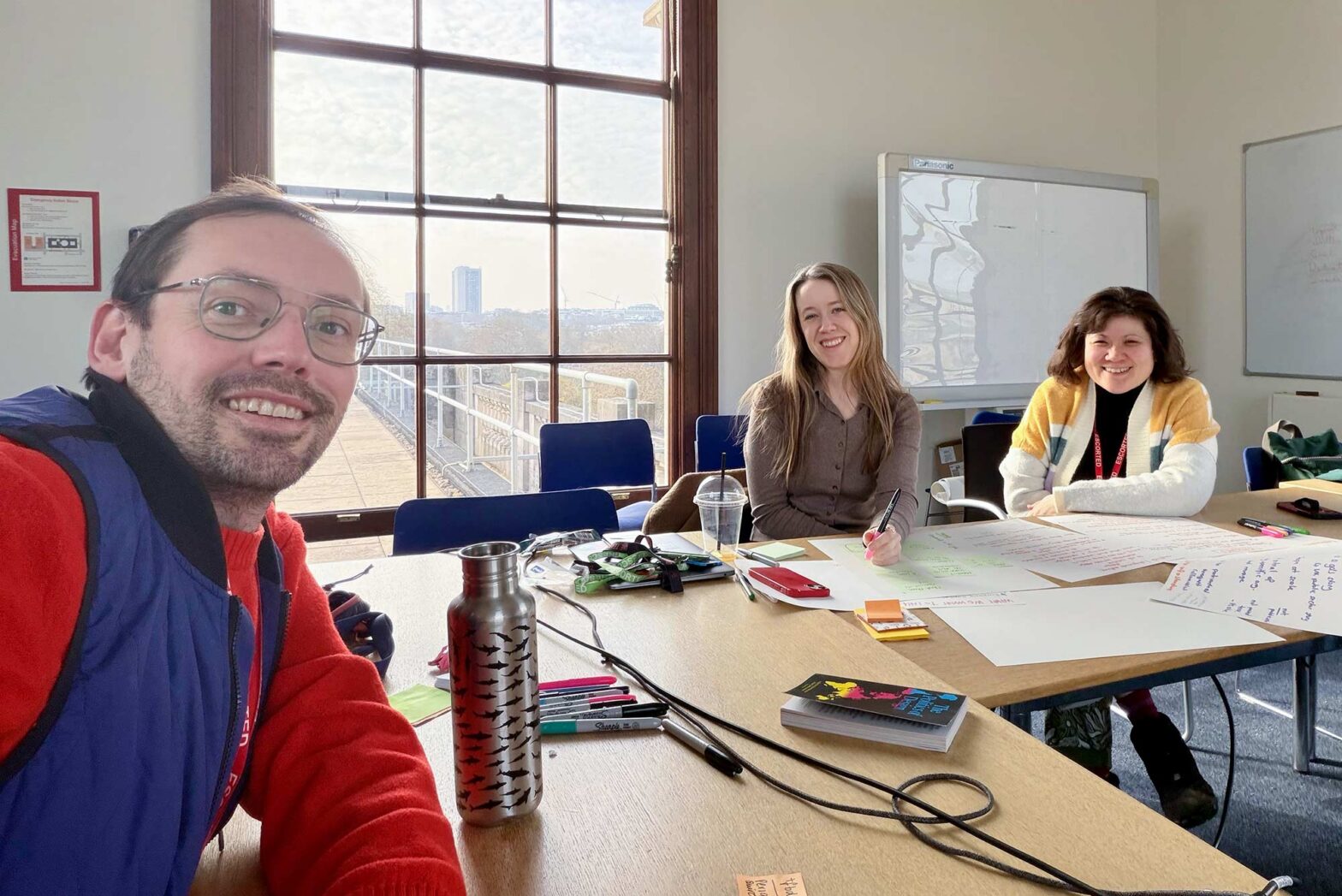
We got back to writing.
On Friday afternoon, Kara, Clara, and I met to start another attempt at writing our book. Ambitiously, we kicked things off in 2021 and set up a website for it, which still displays a progress of 6%. We haven’t done much actual writing for it since then. We all got busy with our jobs and our lives. As we all still sense a need for the book to be in the world and a spark to write it, we met in one of Westminster’s most hidden meeting rooms.
Without looking at our previous notes, we wrote down why we still want to write the book, who it is for, and what it is not. We also listed chunks – aka potential chapters – we are seeing in the book. Each of us has committed to a portion and will produce some material on it. The 2 topics I am currently most interested in writing about are ‘On onboarding’ and ‘Working in the open’. These are topics I have been spending time with and mulling over in the past years. So, while on a train on Saturday, I took notes to serve as input for some pages on the topics. I will dedicate time next weekend.
Having conversations on service transformation, AI and consent patterns
As I spent the second half of the week in London, there was some time to meet with people.
GDS designers Jeremy and Joe were free over lunch, so we met to catch up. We discussed the possibilities and limitations of using AI in design, including the constraints of certain tools in a public sector organisation. Joe shared an article he wrote on ‘Making an LLM/AI web app for GOV.UK prototyping’ with me afterwards, as I asked about the role of the prototyping kit in the age of AI systems and AI-supported prototyping.
Later in the day, I also talked with a deputy director about cross-government service transformation. We discussed what an ‘announceable culture’ does to long-term system change, where senior officials want to know what you can achieve in weeks, even as a transformation project will take years. People are happy to fund visible frontend work, but are less inclined to want for digital infrastructure projects that will bear fruit only in the next decade.
It was powerful to learn more about GDS Local and how it will help vulnerable users with complex cases. There was an acknowledgement that the GDS senior leadership has failed to work openly. There are various reasons for it, including a lack of momentum, cultural challenges because too many new people joined who are not used to this mode of working, and also political barriers (see ‘announceable culture’ and not sharing work in progress). If top leadership doesn’t practise it, the organisation cannot follow their example.
On Friday morning, I met with Valeria, a partner at Projects by IF. For the past decade, her organisation have been working with governments and private sector organisations on trust. They are still among the few consultancies focusing on trust. But they see a much bigger interest in the topic than ever before. We touched on their design pattern catalogue, including consent flows, and discussed how the law differs slightly in the public sector. When a law is the legal basis for granting access to data held by the government elsewhere, there is not much consent to give anymore. Instead, it’s about informing people about what is happening. And when data sharing happens more regularly, much more than once, we shoud be establishing patterns for that. Valeria also highlighted the need for future-proofing data and service infrastructure. In case non-democratic actors ever gain power, user-facing data-sharing logs might help inform people who have access to their data. If we don’t make the infrastructural efforts for that today, we won’t have it when we need it even more.
Co-defining what good looks like
Government doesn’t know what good looks like. Not for services. Even after decades of digitalisation, with billions spent. Now, this is finally changing.
Some 9,000 randomly selected people in Germany received a letter from Minister Wildberger in January. They were invited to shape government’s service quality criteria. ‘Service that delivers’, the letter said. In 1-day in-person workshops across the country, they co-designed what ‘good services’ are and need to be. 90 people in Berlin, Cologne and Erfurt – mapping their service journeys, explaining their pain points and coming up with quality criteria.
We interviewed a few participants to understand their motivations for contributing. Democracy was a strong point they made, even though some were a little scared when they received a letter from a ministry. Another 1,500 people had their say via a telephone and online survey conducted at the same time. Their input complemented the view.
In parallel, we ran 2 workshops with 40 civil and public servants from all levels of government – federal, state, and municipal. In January and March, our colleagues travelled across the country from Bonn, Freiburg, Hamburg and Munich to Berlin. They, too, workshopped the criteria, and they didn’t look much different.
Now, we are pulling the streams together. A large-scale synthesis exercise and extensive content design work are underway. The service quality criteria will find their home on servicestandard.gov.de. Embedded in the ministry’s federal modernisation agenda, ‘better service’ is a focus area, led by Sabrina Artinger’s team. More supplemental work is to come.
Personally, I am grateful and impressed. This is a whole other level of participation and co-creation. This is what participatory design can look like. At a strategic service level, this is extremely rare. For individual services, user research happens at an operational level. But in government standard-setting, this is unseen. Kudos to the Federal Ministry for Digitalisation and Government Modernisation and everyone involved there.
At a more granular level, we continue to write and publish more guidance detailing the Service Standard, enriching it with concrete how-tos. Local government colleagues continue to reach out to us, sharing their troubles with suppliers – and them not meeting basic service quality standards. So, one of my favourite new pieces of guidance is on ‘Designing forms with clear questions’ cause even in the age of AI, government forms aren’t going to go away. Not yet. And so many of them remain terrible. The new guidance helps people who build or commission public services to make them clearer.
Collectively, we are defining and exemplifying what good is – at all levels of abstraction, considering many views. The Service Standard’s handbook section is continuously growing. It’s becoming our guidebook. We are calling on public servants to join our curatorial team to help us find and shape stories.
Writing more submissions
I’m in writing mode.
On Monday, I finished a third proposal for the Edinburgh ‘Service Design in Government’ conference. It took me some time on Sunday to write it.
All views considered: Co-design at a strategic service level
Service quality standards are set by government. But the people affected by them are rarely considered: users, residents, or business owners. What works at an operational level through user research for individual services is broken at a strategic level. When developing new standards, government usually only listens to itself. Most often, the centre of government decides for everyone else.
The German federal government has taken a different approach to strategic service decisions. To define definitive service quality criteria, it asked over 10,000 citizens for help. The respondents participated in hands-on workshops and took surveys. The result is a strategic alignment that includes all views. In tandem, public servants and members of the public shaped what makes service ‘good’.”
That is the 119-word short description. I wrote another 714 words to detail the session. I submitted it 5 minutes before the 9 am Monday morning deadline. Let’s see if any proposal gets accepted.
On Thursday, I produced an abstract for the upcoming Touchpoint journal. It’s a peer-reviewed practitioner journal. I have been contributing to it since 2012. My most recent contribution was in 2024, when I wrote the article ‘Multidisciplinarity as per Service Standard’. The upcoming issue 17/2 discusses ‘Emerging service design’. Partially overlapping in content, at first, I gave the proposal the same title as the other conference submission – ‘Policy and service design as one’. But I wrote the 2,000-character pitch from scratch. I asked my colleague Bene to be my writing wingman if the abstract gets accepted. Bene made some small but vital changes. The submitted title is now ‘Upstream impact: How service designers shape better policies’. We should hear back from the publishers in the coming weeks. Then, we have time to write the 1,400-word piece in late spring and early summer.
This week, I also heard back from the re:publica conference. This year’s topic is ‘Never gonna give you up’. I pitched a talk on making government services inclusive. But for the third year in a row, my proposal was rejected. I will try again next year.
What’s next
Next week, Tito and I will need to make good progress on the website for the cross-government brand and design system.
On Wednesday evening, we will run our 12th public sector innovation meetup. It’s fully booked, with all 100 spots taken and a waiting list building up. I had to confirm to people that we are not streaming but will record the sessions and make them available via YouTube later.
Right before, in the afternoon, Carina and I are going to run an interactive session on life events, utilising some of the OECD material. We were meant to do that 2 weeks ago, but then had to postpone.
I will also start interviewing content designers.