
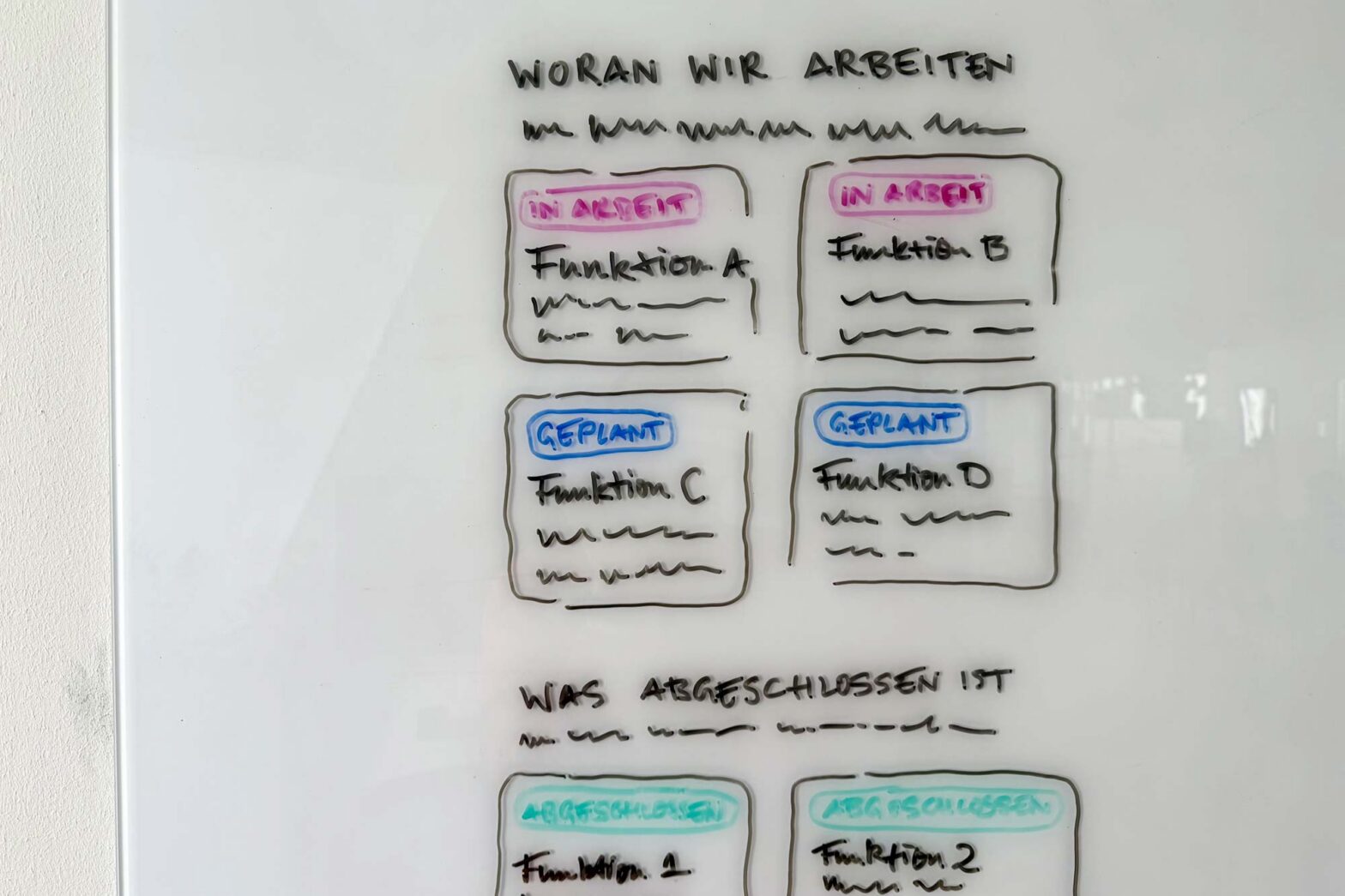
I took things to the board. While Bene and I did not make significant progress on our blog post about open roadmaps, I at least made a sketch.
I shared this sketch with designer Tine and our bench team. I added it to a task on their task board with the request to sketch a design pattern for open roadmaps.
After reviewing recent implementations of such roadmaps in our projects and international examples, I believe we aren’t far from a solid pattern that can be documented and replicated by others.
Prioritising more design system and pattern work
Checking in with developers Aimee and Anne, we looked at several tasks on their board. One includes developing the first version of dachmarke.gov.de. We aim to have that by the end of April. To a large extent, it will follow the design patterns we established for servicestandard.gov.de. A novel functionality will be a live search inspired by get.gov and our US American colleagues.
Another task is restyling our local Formbricks installations with the KERN design system. Tweaking its style sheets to match the visual style of the cross-government brand and design system will allow us to run surveys that feel more integrated.
A third thing we would love to see happening is a KERN design system version of the GOV.UK Prototype Kit. I briefly talked to GDS design Joe about a whitelabelled version when we had lunch 2 weeks ago. I will reach out to him again next week. Aimee and I are excited about finally making our own version of it.
Somewhat related, we had a kick-off for an update to the landing of servicestandard.gov.de. Paul, Linn and I went through the content blocks we might need – based on recent research.
Lastly, we held an internal meeting to detail the ÖFIT study on trust by design and to define its scope and survey approach. My colleagues Lena and Stefan joined for the first time. They brought ideas and sketches for what the survey might be able to answer. We discussed hypotheses and how we could test them.
Celebrating a decade in the public sector
10 years! This week marks a full decade in the public sector. In April 2016, I joined the Government Digital Service as a lead service designer. It changed me and my life.
Why would the UK Government hire a German designer to fix its services? That’s what I wondered back then. And I was grateful for the opportunity I received. While I hesitated in some private-sector roles before, it dawned on me that I may have found my calling. I could bring my full self to the job. Community activities, like running meetups or organising conferences, which I had previously done in my spare time, all of a sudden were useful experiences for my role.
“Your employer is the Crown and you will work for the Cabinet Office”, my contract said. My outsider perspective, given my limited knowledge of the UK political system and government culture and structure, allowed me to ask odd questions at times. There was much to learn. I spent months outside my comfort zone before I really found my footing.
Before, at Nokia, colleagues were chasing the number of patents with their names attached. I realised the measures of success were different in the public sector. It counted how many blog posts you had written, design patterns contributed to, or whether you had assessed a service for another department. Openness and community engagement were suddenly the things that mattered. Not the degree of your competitiveness. That was refreshing, and I continue to treasure it to this day.
I am aware that the 2 digital government units I have worked for in the last decade, Government Digital Service in the UK and DigitalService in Germany, are their own little bubbles. They were – or are – perceived as ambiguous. They are not how everyone else in the public sector works. They disrupt and sometimes annoy; they can be a bit ‘difficult’. That is understandable as they are the places that bring about change, propose radically different ways of doing things, and fundamentally question some stuff. With some rebel tendencies myself, it’s a great fit. Both places promoted independence when I arrived, which I wasn’t used to in other places before. I enjoy that much, too
I cannot imagine leaving the public sector. Why would I? Instead, I wish more people could see both worlds: for civil servants to spend some years in a startup or corporate setting. And people who exclusively worked for profit to join an organisation with a different purpose. For the latter, we have the Work4Germany fellowship. It allows people to dip their toes into another world. Some of them stay for a while; others don’t. Maybe people reading this wonder if service transformation work in government might be something for them, too. It might well be!
I will do my best to promote and enable more good public sector design work – in Germany and abroad.
Taking VoiceOver training
On Wednesday afternoon, I had some educational 50 minutes at the Apple Store.
For 6 pm, I booked myself the Voiceover for Mac training they regularly offer. I didn’t know I wasn’t the target audience. The training was not meant for me. Instead, it is a regular training session for blind people who regularly attend and learn together. The trainer, who is himself visually impaired, was very accommodating and allowed me to participate in the session as well. He gave me a Mac and switched off the screen so that I could navigate with VoiceOver myself. I learned various keyboard functions.
I have tried to become familiar with VoiceOver before, but I didn’t get very far. I went through the tutorial and looked up some introductions. Finally, this session was helpful and made me progress. It’s the introduction I needed to dig deeper into this now.
There was a dimension of othering that I, in my privileged position, rarely experience. The trainer regularly referred to the ‘seeing’ when explaining things and how they are different. He also talked about a personal experience he had when filling out and submitting PDF forms from the German pension provider, which could not be processed. To gain a broader perspective and go beyond my comfort zone, I am glad I went and grateful to have had the opportunity to participate.

What’s next
One short week follows another. And the coming one is not yet fully packed. So, I hope to have more time to tie up the loose ends of articles and blog posts.
I need to finish a contribution to a book for the Creative Bureaucracy Festival, edited by Charles Landry. He asked me to write something provocative. I now have a direction, which I will write out in full in the coming days.
By the end of the week, I also need to write my submission for the Service Design Global Conference, which will take place in Frankfurt at the end of October. The deadline is next Sunday.