
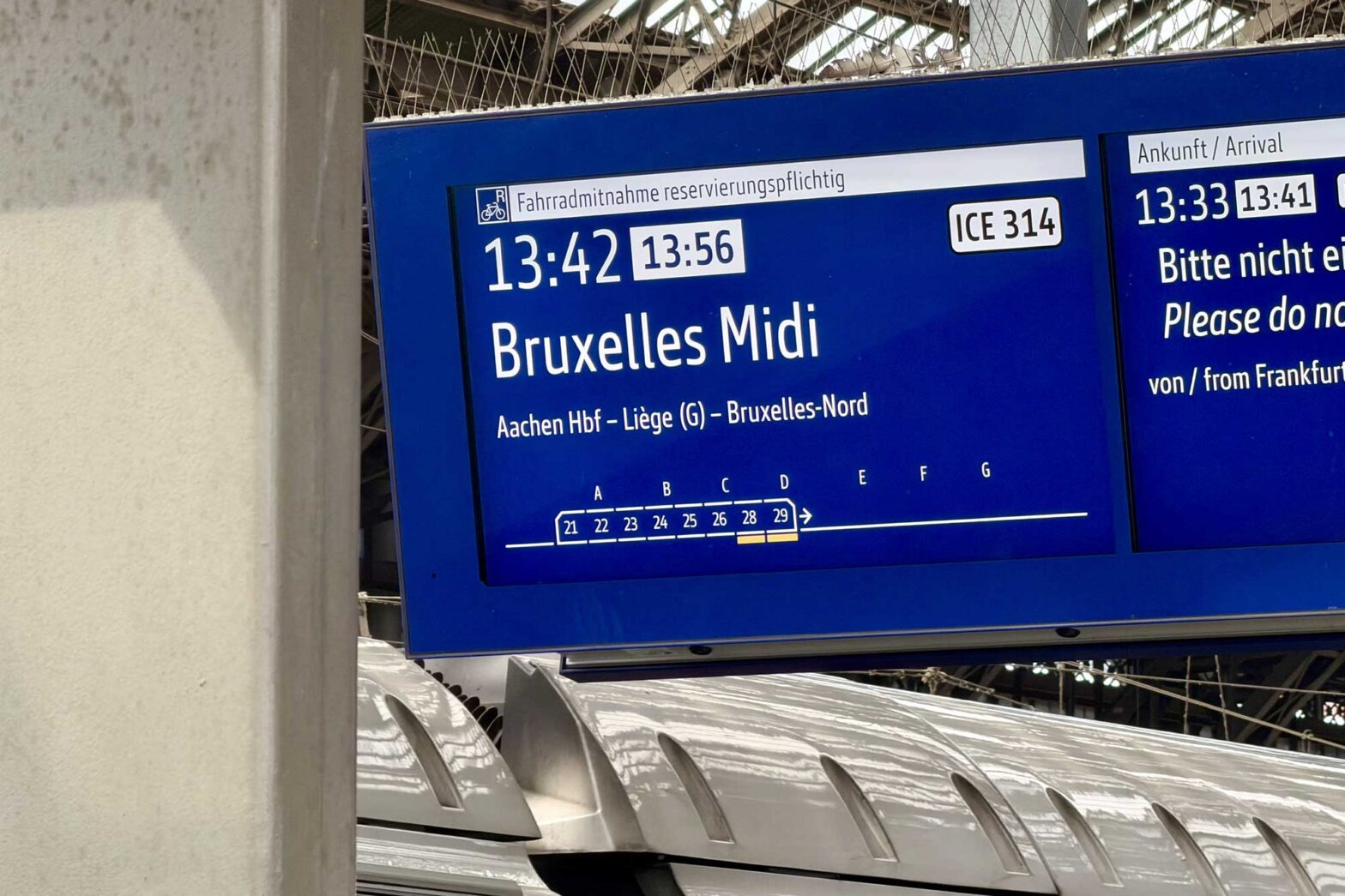
I’m on route to Brussels. I’m writing this note on the train from Berlin to the European Commission in Brussels, where I’ll spend the next 3 days “reimagining policymaking for Europe”. I will attend PolyFutures, an event organised by our colleagues at the EU Policy Lab.
I am hoping for broader inspiration from beyond my own area. I know almost none of the invited speakers, which is a good thing.
The main event runs for 2 days. On Wednesday, we’ll have an extra community day that Kara and I will help facilitate. We’ll use it to visit various Directorate-Generals.
Discussing AI for speedier service
With designer Agnieszka and user researcher Laura, I had a good exchange on AI in the past few days. They work on our ‘Starting a business’ service. As they explore how to speed up service delivery and cut processing steps, we have had in-person and Slack exchanges about how AI could help. I also picked the brilliant brains of Kuba and Tim at GDS.
We touched on alternative input methods and interaction paradigms. That included voice-only interfaces. We also discussed chat interfaces, but we still lack evidence of benefits in terms of speed and precision. Several form-based questions to capture users’ context still seem to work best. Voice-only as an input method for website or app-based services must be disregarded due to the error rates. When entering one’s own name or the company’s name for the first time, people want to get things right. Accuracy wins over supposed speed.
Despite senior stakeholders’ interest in announcing new AI-powered services, we need to verify where it’s useful and where it’s gimmicky.
When AI-enabled systems, behind the scenes, process uploaded business plans and other documents and automatically match the proposed business to a business category code, it saves time. It means less work for the applicant and caseworkers involved.
We will need to spend much time and effort to explore contextually useful AI applications. We need to dig deep and see where it can help us with 80% of the standard cases. It might be deep within the service stack, with no visible difference in the interface or interaction model. That can be disappointing for leaders wanting to announce and show something to the press. But when we can offer them good numbers on how much time is saved, how many steps are cut, and how error rates are reduced, it should help them create a convincing narrative.
Planning for Global Accessibility Awareness Day
Marion, the accessibility ambassadors and I have built a plan for GAAD activities. Global Accessibility Awareness Day takes place on 21 May this year. It’s a good date for us to accelerate our thinking and making. Without that deadline, we wouldn’t have a reason to finish things.
For the past few years, we have run events, created tools, and published articles on that occasion. Here is a recap of the past 2 years:
In 2024, Marion and I published our first blog post on accessibility and launched Wie viele Menschen?, a tool that lets you calculate how many people using your service have access needs.
In 2025, we set up our physical accessibility awareness and testing lab, ran an international call on accessibility and inclusion, and a local meetup on the topic ‘Accessible for everyone’. We also tweaked a – still fairly hidden – page on accessibility to Digital Service’s website.
For GAAD 2026, we are planning the following:
- an interactive 3-hour morning session with the NExT network, including short inputs, case studies and some remote hands-on time
- an advanced German version of the GOV.UK Accessibility Personas with checklists and a to-do section on a newly designed website
- a new blog post on our progress on accessibility in the past 2 years
- a practice report for the Service Standard handbook section
That is quite a list. But we have to stay ambitious.
Planning poster propaganda
This is a little random: We discussed new frames the other day.
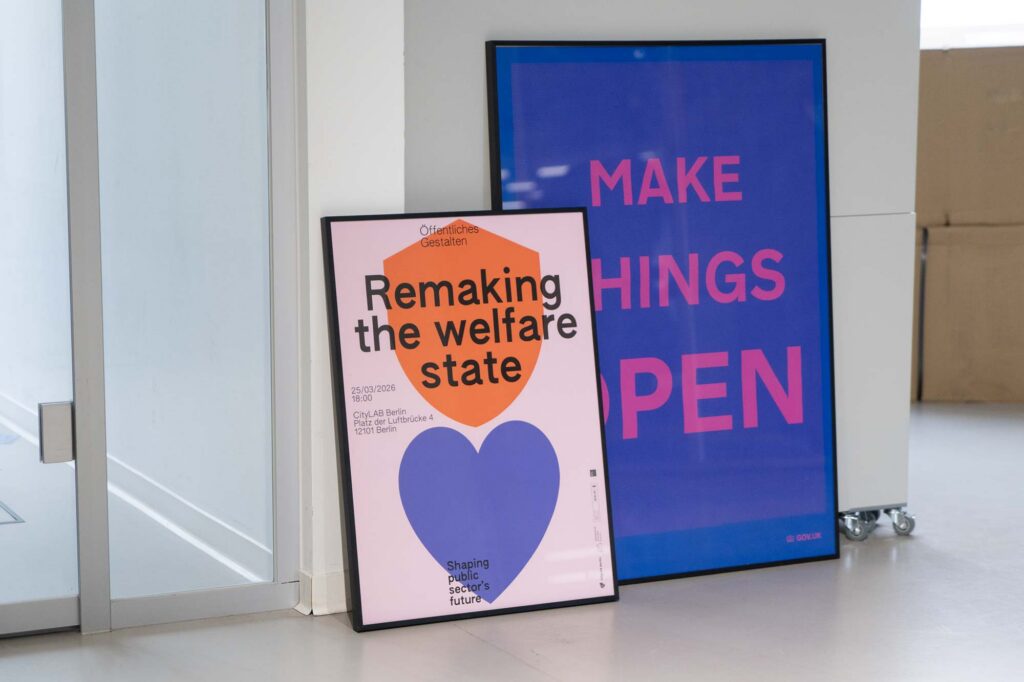
Our posters matter to us. As we prepare the large-print version of our updated delivery principles, I reached out to our communication designers. Bianca confirmed that she has researched more affordable options. We ran out of wall space due to too many glass fronts and unsuitable columns in the office for placing posters. Leaning frames against walls is the only option. But as people might run into the standing frames, we will swap all glass for plastic. Some glass had already broken, and other pieces had splintered.
While finishing the blog post on our delivery principles, I am sorting out the poster printing and will pick up an A1 frame next week.
What’s next
Apart from attending the activities in Brussels, I will dial into an update call on Federal government branding on Tuesday.
On Wednesday afternoon, I will be rushing back from Brussels to Berlin, arriving just before midnight. That allows me to welcome our new starter, Linda, who joined the Service Standard team already this week.
I am using the Wednesday train time for writing. There are now some texts that need to cross the finishing line soon:
- a blog post on our delivery principles – to be published before the end of April
- a blog post on trust through brand and design systems
- a blog post on open road maps – to be published in May
- an opinion piece on AI in government – to be included in a booklet, to be published in June
- an article on service designers and policymaking – with a deadline of 26 April, to be published in September
Of course, that is too much for even 2 train journeys. So I expect myself to dedicate more time to these texts later in the week.
On Friday afternoon, we are scheduled to meet with Siju, who is heading up digital delivery assurance at GDS. He will be in Berlin, and we plan to meet for an extended exchange in our office.
If time allows, we are preparing the job ad for the user research role we need to open.