
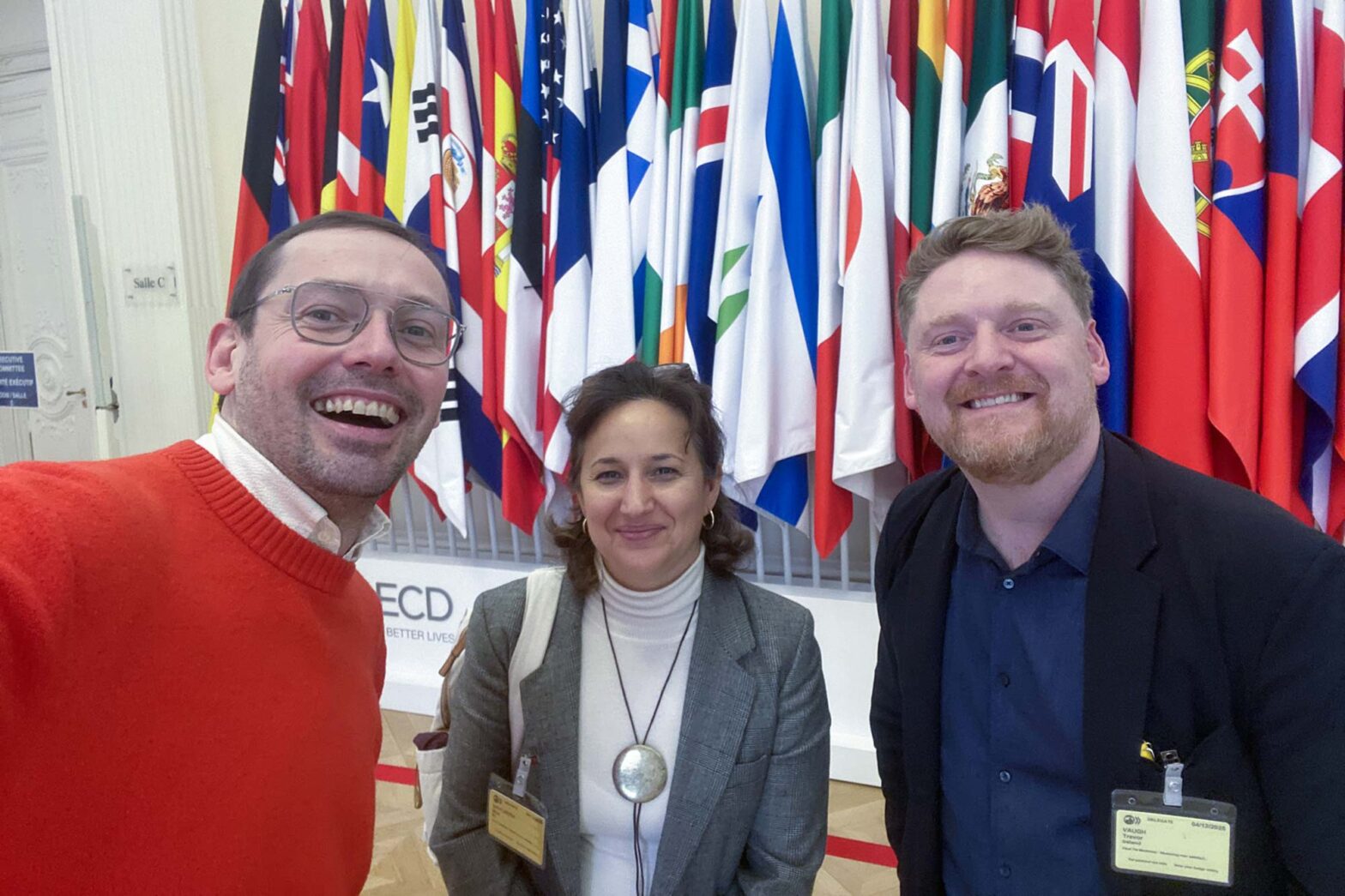
I got to spend a couple of days in Paris for work this week.
It was inspiring and productive days, and I had the chance for deeper conversations with colleagues from various nations and international bodies.
Attending an OECD life event workshop in Paris
What if we fixed public services in a common way across 27 countries?
That was a question at the core of an OECD workshop on Thursday. What if becoming a student or dealing with the death of a loved one were well-supported service journeys? And what if governments had the insights, tools and other resources to make the related services really good?
We had a mature conversation about mending end-to-end and ‘whole’ services that I did not expect – not at this level of maturity. Not across 14 EU member states.
Headlined ‘Best practices in measuring user satisfaction and improving delivery of public services through life events’, I was able to join the final gathering and witness the work of a group of dedicated civil servants from across the continent, assembled by the OECD and the European Commission. Over 2 years, working in and with Austria, Croatia, Estonia, Finland, Greece, Ireland, Latvia, Lithuania, Slovenia, and Spain, they conducted surveys, examined good practices, and identified key drivers of citizen satisfaction. The outputs are relevant and valuable for all 27 EU member states.
In the survey, there were some powerful findings: a drop of over 10 percentage points in citizen satisfaction when citizens encounter more administrative contacts than expected. So, once-only truly matters. User satisfaction is almost 30% higher when users do not have to re-enter the same information. When it takes 5 or more separate interactions to reach an outcome, satisfaction goes down significantly.
The work identified 9 key drivers for overall satisfaction with services. They are closely aligned with the Service Standard and the GOV.UK guidance on ‘characteristics of a good government service’ that I helped shape. That was encouraging to see.
During the day, led by Emilie Balbirnie and her colleagues from the OECD, I learned about the European Commission’s significant push for joined-up service design. I had particularly productive exchanges with Mina Shoylekova and Trevor Vaugh and felt a shared sense of purpose. As part of the afternoon, we went hands-on. We tested a new OECD toolkit to model a life-event approach to service design. I also had the opportunity to share some work from Germany.
Inspired by the work of the OECD and the EU, I am delighted to see a similar push for vastly improved services in Germany through the modernisation agenda. A team responsible for its better services section are promoting a service lens that has been underdeveloped in the German government with several service-related workstreams. The coalition agreement of our current government also references services aligned with ‘life events’ 3 times.
That’s why we at Digital Service are sharpening our focus on life events currently. Right now, we are conducting user research with people who recently started a business. We also work on larger service journeys related to justice, social benefits and family benefits. Cause focusing on life events makes our services better.
Taking an afternoon to reflect on AI use in our discipline
AI in our public service design work is here to stay. But we need to reflect on its use and take time to assess its impact.
Generative AI tools have slowly but surely become part of our discipline’s tooling and operational practices. They support our work and, in turn, the development of better services for the public. Yet there are – and will remain – questions, concerns, and a generally persistent need for assessment of use.
On Tuesday, our design and user research discipline came together for an afternoon to reflect on the year, check in with each other and look ahead. We do some stocktaking every December. This year, we discussed the use of AI in our work for a bit longer. In recent months, we used our weekly discipline sessions to compare how we use AI across our subdisciplines. Every discipline is different, works in its own way, and uses very different AI-supported tools. Our communication designers may use it to refine images, our user researchers to find patterns in datasets, our UX designers to explore design variations, and our content designers to check language levels or get an alternative take on a particular complex sentence in legalese.
For the afternoon, my colleauge Sonja created an AI canvas for reflection. It helped us collect resources, discuss opportunities and limitations, and sketch some guiding principles for each subdiscipline. “Always check” showed up everywhere. “We are the original LLMs.”, our content designers beautifully concluded.
It goes without saying that our environment doesn’t allow a bring-your-own-tools policy. The tools we use undergo a thorough data privacy assessment and are GDPR-compliant. We select our suppliers accordingly, even though this means we must exclude some.
During the afternoon, my dear friend Mauro stopped by. He zoomed out and provided an overview of what AI is for designers. He made the point that AI is a solution for service providers, not the service users. That it is a solution layer in the service stack. There, it may help offer a better-scaled service at a reduced cost, with greater control over delivery and quality. Mauro also reminded us that AI integration is bidirectional: it allows users to get closer to their goals while the machine learns from the interaction.
Our work goes beyond ‘designing with AI’. The second half of the year also included ‘designing for AI’ as we worked on a Federal government AI suite. It equips civil servants with time-saving tools in their day-to-day work. The work showed us that work on AI products doesn’t fundamentally change our ways of working. We spoke with users, learned about their behaviours, and conducted surveys to gain deeper insights. Mixed-method user research approaches, UX heuristics and usability tests don’t go away in the age of AI.
It’s critical to discuss and explore AI in public service design together. In times of uncertainty and rapid change, our team needs to share what we observe, hope and feel, and also fear.
What’s next
Next week, I will try to get blog posts finished and out.
I will also conduct interviews with several candidates.