
I am getting there.
In August, I planned blog posts and other publications for the second half of the year.
On Tuesday, we finally published an update on our international activities. I wrote most parts in late August. Things then got stuck in the UK Cabinet Office’s comms department. Kara managed to unstuck it eventually. It was one of the blog posts listed in late summer.
In the post, we give an update on International Design in Government community activities throughout this year. We recap the Amsterdam conference, the newspaper we made with the community, and our ‘design for policy’ workshop activities around the Creative Bureaucracy Festival in Berlin. We also give an outlook to 2026: the PolyFutures conference of the EU Policy Lab, more community calls throughout winter and ongoing activities from the Nordic-Baltic community, which might also result in an event in the second half of the year.
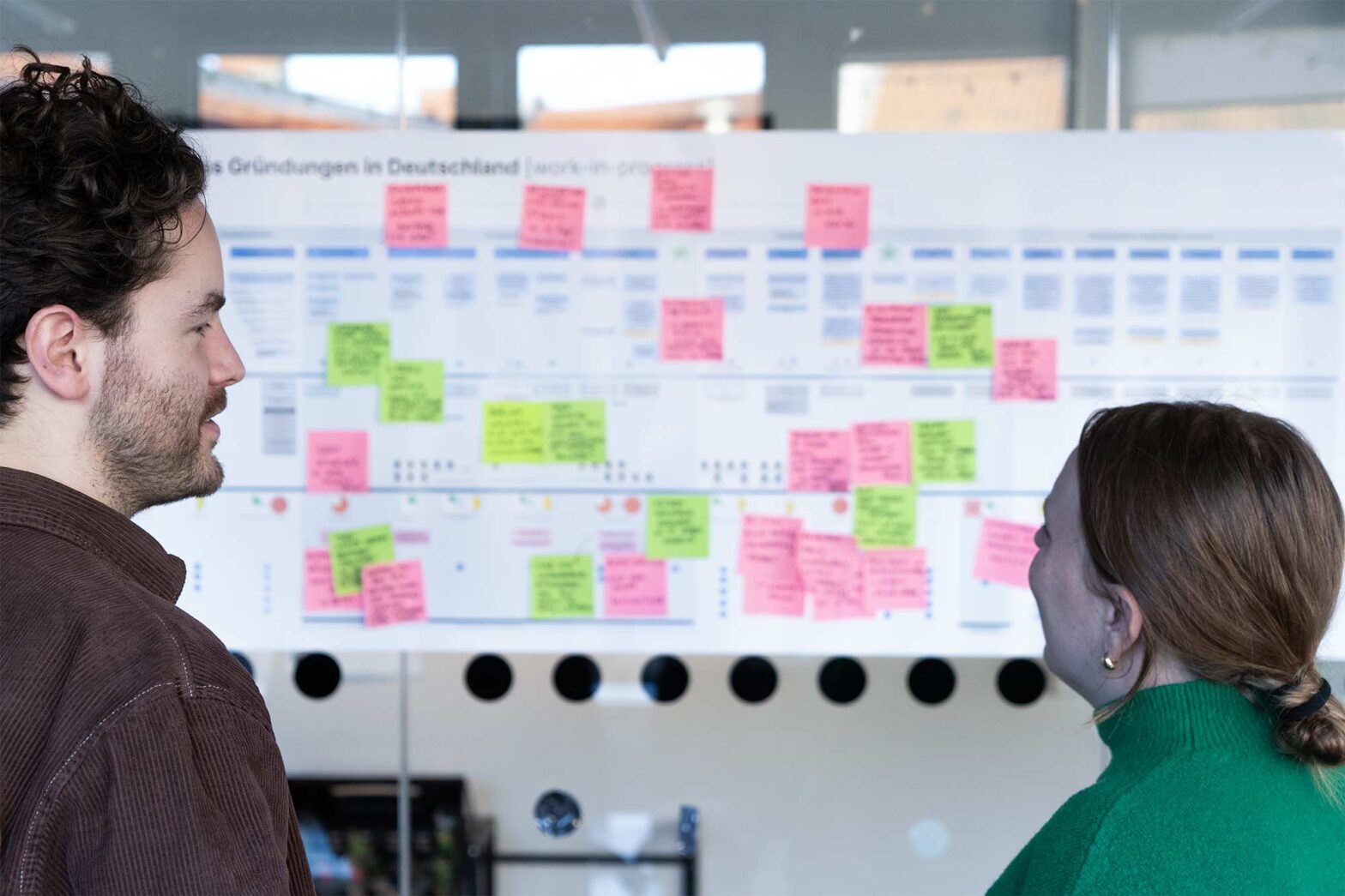
For the next blog post, I have been sourcing journey maps I could use for the header image. People in front of a blueprint or journey maps feel like a standard stock image, and I have taken several of those in the past decade. Yet these are needed to exemplify that the work is real. Eventually, I took a relatively fresh overview of starting a business in Germany. It’s one that a team recently put together for one of the minister’s priorities. My colleagues Joshua and Chiara kindly posed for the picture.
On Friday, I also had a catch-up with Melike from the NExT network. She has been the first full-time community manager for the cross-government network, joining in late summer. It’s a vital role. With 17 communities and several format series, more support is needed for those running communities.
We discussed potential crossover events among different communities. An obvious one would be between our user-centred design community and the accessibility testing community.
This year, I only managed to run 3 community gatherings instead of 4. I always aim for 1 per quarter. Things were too busy on both Maria’s and my end. I hope to return to 4 gatherings in 2026. I have some topics on my mind, but we might need to collect some more from community members. I would like to hear more about and see more of life event approaches, after colleagues in Munich and Hamburg did quite a bit in this space.
Interviewing for service and UX design roles
Looking for both interaction (UX/UI) designers and service designers, I conducted 4 interviews in total this week, 2 for each role. The service design role is advertised; the other one is not. We have a robust talent pool from which we source UX/UI candidates. One candidate expressed surprise that we reached out over a year after we last spoke. Apparently, it was the first time an organisation had done that. They told us that talent teams might say they will return once more opportunities arise, but that has never happened. Throughout 2025, we hired 4 people from the talent pool as we did not have the capacity to open up roles broadly.
We have been shifting applicants between the two roles we are hiring for. Some service design candidates seem to have more experience as UX/UI designers. Given the greater variation in the understanding and definition of service design than we have seen in the UK, we need further clarification from our side. That means I have to finish a blog post on services and service design.
Extending our Service Standard work
Our Service Standard work is currently growing in scope.
We are looking into additional work to define service quality criteria. The German Service Standard focuses on how teams should work to create, commission, and manage good services. This adjacent work covers the characteristics of good services themselves. We did similar work in the UK a few years back. It resulted in guidance on good services. There, we took a broad co-creative approach, involving many civil and public servants. For Germany, we plan to do the same. So, I did quite a bit of outreach to the network I’ve built across the German public service in the last years.
On Tuesday, we kicked this work off with a 90-minute workshop to set the work’s direction, approach and boundaries.
What’s next
On Tuesday, I will participate in an information call about new work adjacent to the Service Standard that I am excited about. We will have people from across the country and at all levels of government join us.
It’s almost mid-December, but I am still aiming to publish another blog post. I’ve made good progress on our long-awaited text on service design and taking a service lens to government.
I will also need to finalise staffing for new projects starting in January. We have 2 discoveries with new federal bodies we have not worked with yet. We want experienced designers to take on this work. We also have a new user researcher joining us at the beginning of January. To get into the work and our way of working, I want her to join an established team.