
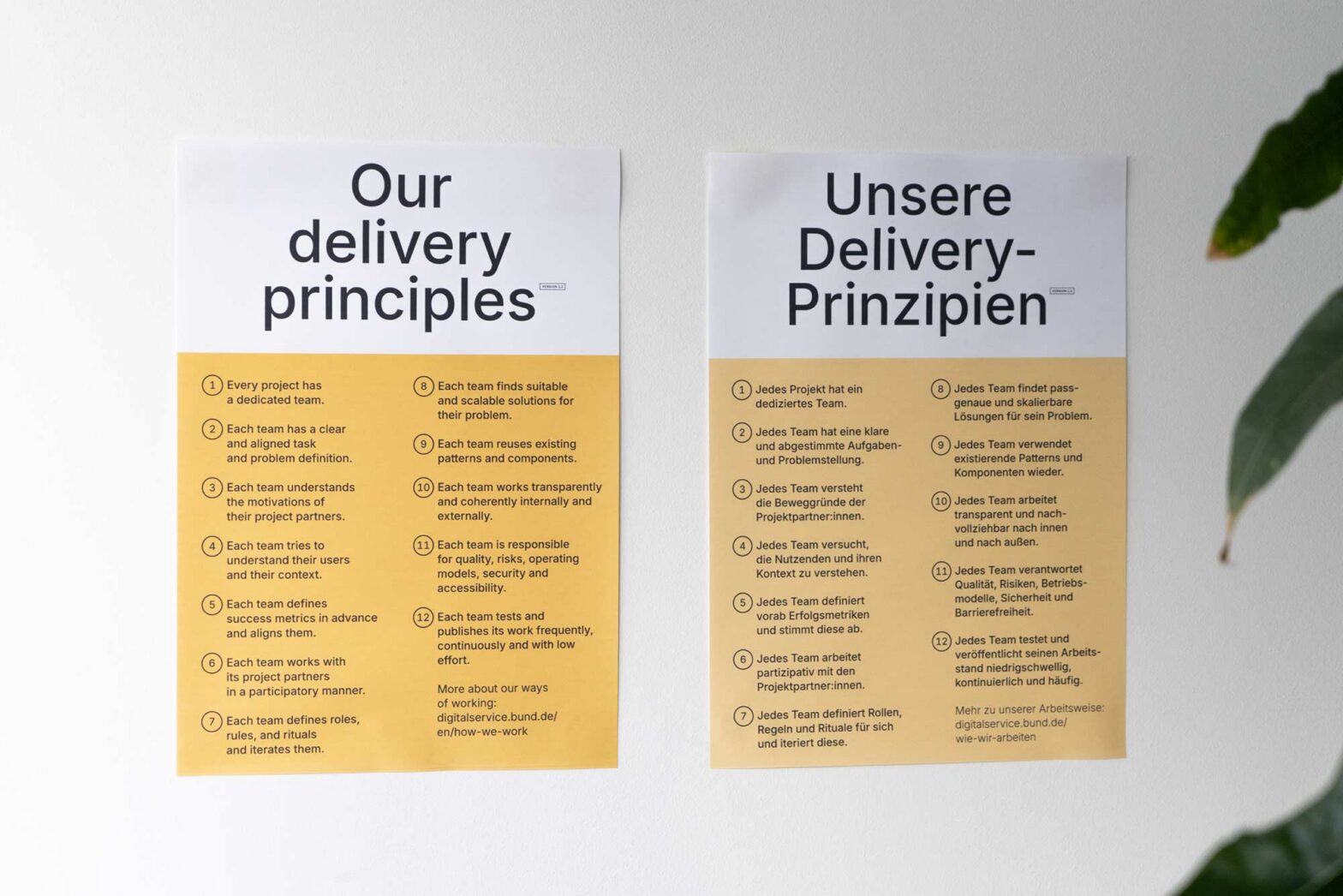
It’s been almost 2 years since we created and shared our delivery principles. I wrote about them in my notes from week #109.
Clara, our Head of Product Management, and I had planned to blog about the delivery principles for a while. This week, we made good progress.
Writing about our delivery principles
In between writing my sections, I tried to redesign the poster on Tuesday afternoon.
Between printing the draft, taking the picture above and writing these notes, we made further changes. All are minor. In the past few weeks, we tweaked phrases, cut words, and rearranged the order of the principles. The individual principles should be sequential and align with how teams do things.
When first outlining the text, Clara and I emphasised how we don’t want to make it bloated.
Still unfinished, it currently sits at 2,173 words. In the coming days, we’ll have to wrap it up and cut it by a good margin. In the blog post, we tell how we arrived at the first version of the delivery principles, how we iterated and how we use them. We walk through each of the 12 principles, explaining what they mean and what they look like in practice. Often, we give 1 or 2 examples to illustrate the principle in action.
The blog post is for 3 distinct audiences. We write it for potential candidates who are interested in what we are working on and how we do it. That is a question that often comes up in hiring interviews. Having a blog post we can reference in job descriptions should help both applicants and us. The second audience is ministerial project partners. Before working with us, they should be able to learn what it’s like to work with us. A tertiary group are colleagues from other digital public sector units. We found quite a few differences in how we work, and hope this post can lead to an exchange about approaches across our units.
Despite travelling for the next 1.5 weeks, I plan to have the blog post out before the end of the month. I expect us to arrive at a final version of iteration 1.2 next week. Then, a bigger A1 version of the poster can go to the printer.
Collaborating on websites
Between Tuesday and Thursday, I had various check-ins on websites. We are currently expanding servicestandard.gov.de and building dachmarke.gov.de. Wherever possible, they are reusing design patterns.
I met with developers Aimée and Anne to see where they are and what obstacles they face. For dachmarke.gov.de, the website introducing the cross-government brand and design system, we drew some inspiration from get.gov. Our US colleagues’ page has a live sub-domain search. I like to see that in our first release, too. We explored whether we need to maintain a separate list in a database or can rely on an API from the registrar. The latter seems to be possible. I won’t cover 100% of the use cases, but far over 99%. For the first release, that is good enough.
As servicestandard.gov.de grows, designer Paul is looking at the site’s information architecture and navigation. Together with content designer Linn, developer Anne, Paul, and I, we had an intense and productive option-sorting session on Thursday. We discussed options and will gather again next week. There are still insights relevant from the research we did for the GOV.UK Service Manual. At the same time, the offering in Germany is already more diverse and should be more integrated. That leads to different challenges.
Lastly, I provided feedback on the now-relaunched justice service platform at service.justiz.de. The design and engineering teams swapped the design system and revamped the visual language. There are a few things that aren’t perfect yet, but they have all the issues on a board and address them in the coming sprints. It’s powerful to see yet another platform adopt the cross-government design system KERN. A blog post about the transition work is in the making.
Pitching another conference talk
A few weeks ago, I wrote several proposals for talks. On Saturday, I wrote another one. This time, I pitched a talk for the Service Design Global Conference. It takes place in Frankfurt at the end of October.
The call for submissions was open until Sunday. So, I spent some time over the weekend finishing mine. The talk mirrors the article I recently pitched to the same organisation’s journal. I even reused the title: “Upstream impact: How service designers shape better policies”.
For the pitch, I had to write an abstract, a teaser and explain how the talk would link to the conference theme. The theme is “Beyond boundaries: Enabling solutions that shape tomorrow”. In total, I wrote 1,332 words. That makes this submission quite laborious. It’s nothing you do in a couple of hours. You need at least half a day to collect your thoughts, write the various texts and create a video.
In addition to the texts, submitters had to record a video of 3 to 5 minutes. They asked not to submit previous recordings of talks. The purpose is to convey the presentation style. Mine includes a lot of gesticulation. It took me about 10 takes to arrive at a version that was good enough. By far, not everyone can spend half a day on a weekend preparing their talk outline and making a video. Such requirements exclude many people who have great things to share but not the time, for example, due to caring responsibilities.
I created the video with the help of a teleprompter app that recorded through the phone’s front camera. It worked remarkably well.
Here is a good section of my abstract for the talk:
Designers have been trying hard to redesign public services for the past 15 years or so. They ran into countless obstacles. By far one of the biggest barriers to their success has been policy. Crucial decisions had long been made before service designers got involved and were tasked to improve a service. But you cannot achieve vastly improved outcomes for people when much has already been set in stone by the time your work starts.
‘Move service designers further upstream’ has been a common desire for public designers in the past decade. After understanding how government works, service designers realised they didn’t show up early enough. As a consequence, the impact of service design is stymied. For service teams handed detailed implementation instructions defined in policy, work can get frustrating. They cannot reach their full potential.
Germany, a bit of an European laggard in digitalisation and rather late to bringing service designers into government, has made surprising progress. In the past 3.5 years, the Federal government’s Digital Service has built a 20-person-strong team to reshape how policy is developed and how policy teams are supported.
Small teams of product managers, service designers, and software engineers run policy discoveries when the first internal policy draft in a ministry is about to emerge. These policy discoveries last between 4 and 12 weeks. The results are a broad range of findings documented in visualisations of existing processes and offerings. These are developed through co-creation sessions with policy officers and field research. Instead of looking at a policy merely through the lens of law, the broader context is taken into account from a user, digitalisation and process perspective.
The talk includes a case study that provides an overview of the progress made and how it was achieved. It documents how mandatory digital-readiness checks for new and revised policies have been used to ensure they are fit for the 21st century. It also highlights how Germany’s Service Standard, as a now-binding legal instrument, closes the policy cycle. Now, when designing a service, teams have to work on ‘Identifying legal impediments and improving regulations’. Reviewing the underpinning rules of a service is now mandatory. It’s no longer a thing far outside of the reach and remit.”
The conference is comfortably close. Frankfurt is less than 5 hours away from Berlin by train. Last year, the event was held in Austin, Texas. I did not hear of anyone attending it. In 2024, I joined it in Helsinki. The year before, Kara and I spoke about the long slog of public service design at their Berlin event.
What’s next
Next week, I will only work for 2 days and then head into a short birthday vacation.
On Sunday, I will then travel to Brussels for the ‘PolyFutures – Reimagining policymaking for Europe’ event. On Tuesday afternoon, we’ll have a final check-in call.