
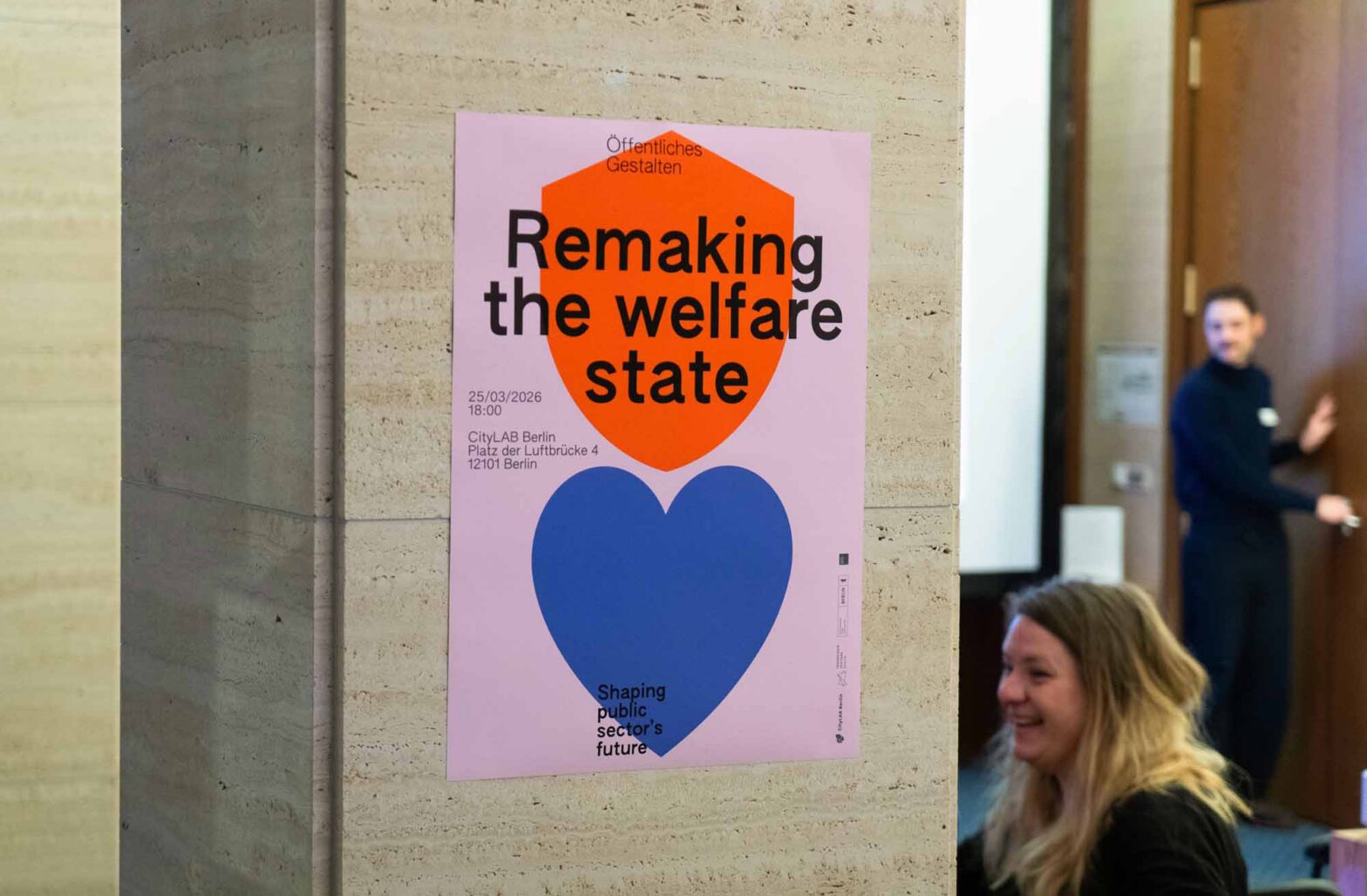
In late March 2026, we ran the 12th edition of our public-facing meetup on public sector innovation. We dedicated the evening to the theme ‘Remaking the welfare state’,
The event description stated the following:
A welfare state takes responsibility for its people and supports them when in need. When costs are rising, but budgets aren’t, government needs to find efficiency gains to maintain social protection levels. A government-commissioned report recently recommended ways to modernise social and welfare services, making them more people-friendly and less bureaucratic. Meanwhile, small and large projects are underway to make benefits services more fair and easier to navigate, and to make the state overall more equitable.
At our March meetup, we will hear about what a modern, digitally transformed welfare state looks like.”
The first presenter was Dr Florian Theißing, Innovation Lead at think tank Agora Digitale Transformation. He shared a study on housing benefits in Germany and how they can be digitally reimagined, seeing social benefits as a blueprint for user-centred digital government.
Afterwards, my Digital Service colleagues Anja Mayr and Jakob Häußermann shared their work. Anja works as a Senior Transformation Manager, while Jakob is the Unit Lead for Digital Welfare State at Digital Service.
In their talk, they presented the findings of their discovery work on improving access to free school lunch as an education and participation benefit. It was carried out in partnership with the Federal Ministry for Education, Family Affairs, Senior Citizens, Women and Youth.
Lastly, Björn Mohr, Innovation Lead at CityLAB Berlin, shared their work on agentic AI in public services. He discussed moving beyond forms to help people get social benefits.
It is a project launched in October 2025, run in partnership with the Senate Chancellery of Berlin and the Senate Department for Labour, Social Services, Gender Equality, Integration, Diversity and Anti-Discrimination, with support from Google.org.
The event received a 4.9-star rating based on feedback from 8 people. About 65 participants joined the event.