
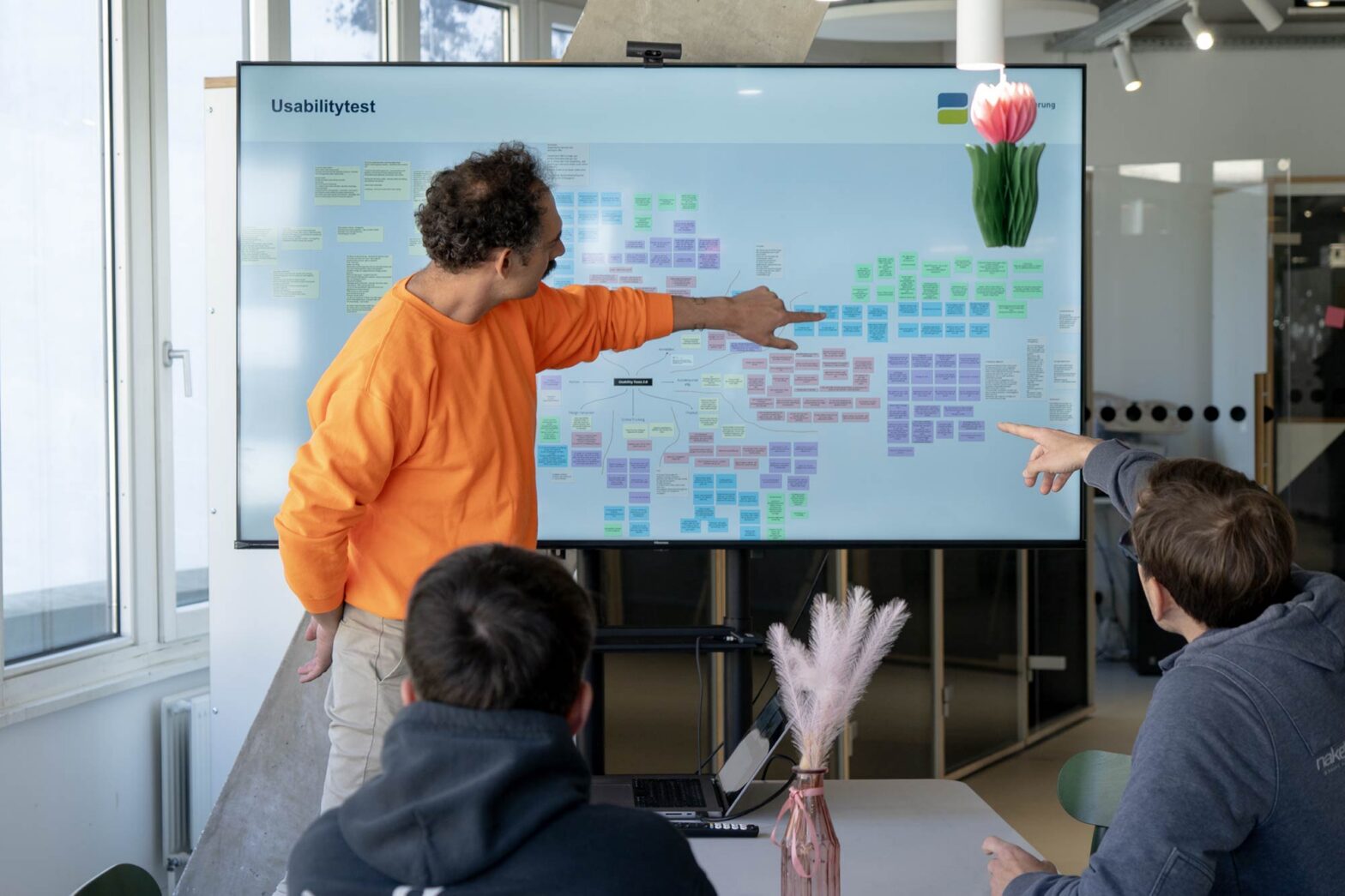
Some encounters are unexpected, like the one with Felix this week. He is a senior UX designer, working for the State Pension Provider – Deutsche Rentenversicherung Bund. He started last autumn in the online portal unit. In recent months, he set up user-centred design processes and conducted research with participants on their portal.
As he contributed an ‘in-practice report’ to the Service Standard handbook, I took on the task of complementing the missing pictures. For that occasion, he offered to stop by our office. We shot some pictures and got to share notes.
I am delighted to see more user-centred design practitioners joining the public sector in Germany. In our monthly user research exchange, we now have 18 public sector organisations represented – all by practitioners.
Felix and I agreed to have a joint team lunch in the coming weeks. Their teams have been growing significantly over the past 4 years or so. Currently, they have 3 roles open, a sign of their continuous growth, which I am delighted to see.
Zooming in and out on the Service Standard
There is rather little mid-level work happening at the moment.
New service designer Linda arrived 2 weeks ago and is still getting an overview while also jumping into very concrete work. We have had 3 shorter sessions so far, during which I have given her an overview of the Service Standard work. I only had to cover 6 years and a bit.
This week, she served as a notetaker during some of the concept testing sessions Paul ran. We are 5 participants in our next round of checking hypotheses on how a more granular questionnaire-based self-check can help users of the Service Standard.
I managed to attend 1.5 of these sessions and listened to both a public servant from a local and a state level. The biggest question for many remains whether the standard applies to them. While the concept test continues early next week, we are already seeing emerging patterns. People don’t consider themselves responsible for quality, even though they are in charge of bringing more digital services online. They are dependent on digital platforms and tools procured and commissioned by others. We need to find further interventions here.
Slightly related: The website for the cross-government brand and design system is coming together. Version 1 is almost complete. It shamelessly steals the great little domain search from get.gov. The feature looks and feels very similar to what our US colleagues at USDS built.
Looking forward, we discussed how all the building blocks need to come together now: the Service Standard, the brand and design system, including the unifying domain, and Federal IT architectural guidelines. A policy instrument that should propel us is the digital spend control that the digital ministry builds. Already last Friday, we met with UK colleague Siju, who heads up the government’s digital delivery assurance and spend control processes. There is much for us to do in that space and to pull distinct threads together.
Stretching between bold brand and bland
A sudden point of discussion this week has been visual language and branding of digital touchpoints. There seem to be 2 camps – both outside our organisation – with one arguing for greater boldness, the other for more considerate blandness. The surprising thing is that the roles are reversed: Senior officials want more fresh branding and more colours, while the designers want more neutrality. As mentioned, it’s a discussion that arrives at our doorstep, which doesn’t originate in our organisation. My views are less one-sided.
“You are not designing for your friends here” is a sentence I heard a few times during my 4 years at Thomas Manss & Company. Everything the international boutique design consultancy did was catered to the clients they served and the audiences they tried to reach. The 5-star luxury hotel in Spain had a different proposition than the German Foreign Office or a state’s business development agency. The same applied to a tech healthcare startup. Design was about appropriateness. This resonated with me a lot. Of course, we were interested in bold clients. But we also saw ourselves as translators and researchers in the needs of the audiences they wanted to reach and communicate with.
The discussion has now been lingering for various months. But this week, it came to the forefront from the 2 opposing sides. It appears neither fraction has done sufficient research into what they actually need. We are destined now to moderate this discourse and offer pathways. I am glad we are at this point and curious where this leads in the coming months.
Talking good form design and accessibility
It’s been a few months since my last podcast.
On Monday at noon, Cathie and Michael, who are running the accessibility podcast ‘Unlimited‘, stopped by. Its sub-line is ‘digital for all’. What was scheduled for an hour turned into a conversation of almost 100 minutes. Michael heads up the BFIT, the German federal monitoring body responsible for ensuring that digital offerings from public bodies are accessible. Cathie is his podcast co-host and moderator.
We sat down to discuss good form design. For much of the conversation, we remained largely high-level and non-technical. We discussed ways of working, legal and technical impediments to accessibility, as well as cultural and structural ones. We touched on the Service Standard as an instrument to support and encourage good practice from the ground up. I didn’t have the space to mention the range of activities we at Digital Service carry out, including the internal tools we have developed and made open to everyone.
The podcast episode should be out in June.
What’s next
I am far from done with writing. My contribution to the book ‘Creative Bureaucracy: Common Sense for the Common Good’ got accepted. Editor and organiser, Charles had zero edits. My piece, ‘A tool to refine, not a magical solution to fall for’, will appear next to texts by various people I admire. Among others, Mariana Mazzucato, Indy Johar, and Arianne Miller contributed to this publication.
I am finishing our delivery principles blog post and have the next 2 lined up as well. By end of May, I need to get 3 blog posts to the finishing line, covering the topics delivery principles, open roadmaps, and accessibility maturity.
Next week, I will continue to immerse myself in salary cycle conversations. It’s important, but not my favourite activity, and I sense that many in the organisation feel the same.
On Tuesday afternoon, we’ll have a ‘Let’s talk vision’ session with our new-ish CTO, Erik. Designers Charlotte and Tine have been organising these executive conversations since before I joined the organisation.
On Thursday evening, we also have a social event with the designers and user researchers planned. It is necessary to have time for exchange beyond the meetings.
Furthermore, we plan to open our user research roles. We will run an interactive session with the designers and user researcher on the overlaps and differences between our user-centred disciplines at Digital Service in our weekly session on Thursday morning.