
What we do is still uncommon: Developing digital government services in-house! Even in 2026, it remains an exception in Germany. Making it work has been a trial-and-error voyage.
Almost all digital development still gets outsourced and procured. Unlike other European countries, Germany has never jumped on the in-housing bandwagon with confidence. Only a fraction of development happens at internal units like ours.
Having worked in a unit of the UK Cabinet Office before, I found our setup a little odd: DigitalService is a limited company 100% owned by the Federal government. Moving here 4 years meant I was no longer a lifetime civil servant but an employed public servant. I don’t work in a ministry but with and for a ministry. At DigitalService, we aren’t the policy or service owners. Instead, our ministerial partners have the decision-making power. Sometimes – I need to admit that – I wish our setup were a bit different. But it’s still the most useful setup we can have for now.
Blogging about our delivery principles
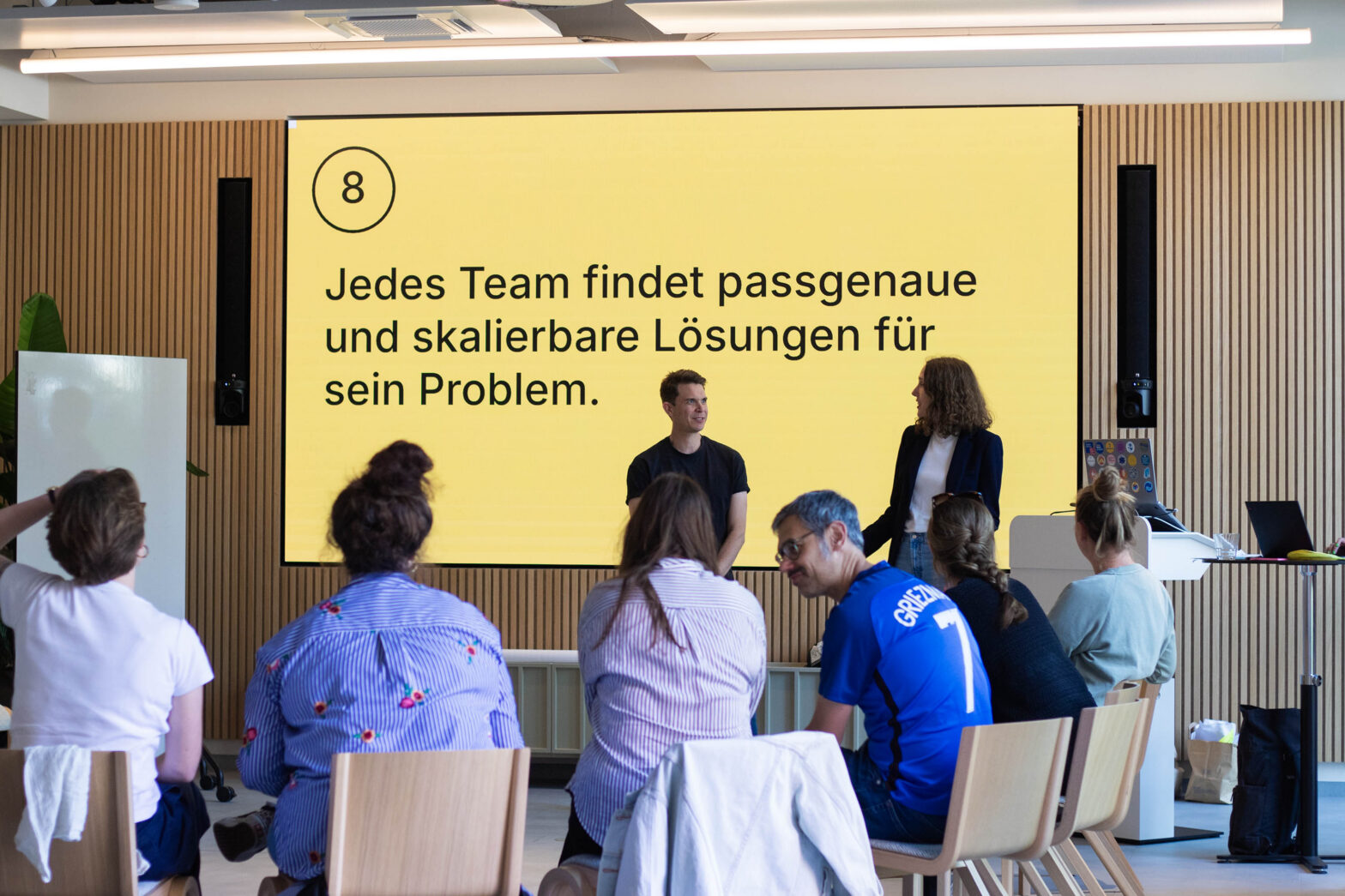
What we learned, we put into 12 delivery principles. These principles are specific to our unique context. And we iterated these as we learned more. Now, 2 years since their creation, we are at version 1.2, our third edition, and we have finally taken the time to blog about them.
These principles are written to maximise our impact within our distinctive setup. So we reference them regularly, and they have been part of the onboarding of all new starters since 2024:
- Every project has a dedicated team.
- Each team has a clear and aligned task and problem definition.
- Each team understands the motivations of their project partners.
- Each team tries to understand their users and their context.
- Each team defines success metrics in advance and aligns them.
- Each team works with its project partners in a participatory manner.
- Each team defines roles, rules, and rituals and iterates them.
- Each team finds suitable and scalable solutions for their problem.
- Each team reuses existing patterns and components.
- Each team tests and publishes its work frequently, continuously and with low effort.
- Each team is responsible for quality, security, risks, operating models, and accessibility.
- Each team works transparently and coherently internally and externally.
We, as the Discipline Heads, developed the principles by reflecting on successes and failures. They are our collective learnings from various projects, created to guide multidisciplinary development teams. Some teams want more freedom. Others want more orientation. What they need depends on their size, project phase, broader circumstances, and maturity. These factors are not static. So the principles must leave sufficient room.
At length, Head of Product Clara and I wrote about the principles in practice in our German-language blog post. It turned into a 2,600-word piece over the past few weeks. At the end, we couldn’t even look at it anymore. We just wanted the post out and done.
The updated posters are on GitHub.
We are always interested in an exchange about how other in-house digital units operate. So I shared the blog post with peers at CityLAB Berlin and DigitalAgentur Brandenburg. I hope for further exchange. Because these principles are not done, and we want to continue learning.
Participating in our annual salary cycle leadership offsite
Spending the first 2 days of the week at a nice offsite meant we ran our annual leadership workshop to wrap up the salary cycle. The salary cycle usually keeps us busy between March and June. We are reaching the end of that, finally.
At Digital Service, people don’t have to ask for a raise. We have a structured process for collecting feedback, assessing people’s development, reflecting on their impact, and recognising their progress against our skill matrix and job family framework. The process changed only slightly this year, while there was more iteration in previous years. With over 260 people in the organisation now, we no longer have time to discuss everyone. So, we focus on outliers, promotion cases and level progressions. To inform a decision, we collect many more data points than I saw being gathered at GDS or Nokia before.
Last week, I insisted we have a sync among the discipline heads. That was indeed helpful. It surfaced a few cases where additional data points were still needed.
My colleague Anna-Lisa, our Head of People & Workplace, blogged about our approach to compensation and remuneration a little while ago. It stirred up some conversation in other digital units.
Getting some leadership training
As part of the leadership offsite, we also got some hours of custom training. Recognising a specific need, facilitators Fabian and Elisa ran a day on decision-making in our organisational culture.
There was room for discussion, there were hands-on exercises, and a practical framework was shared. It was a more-than-robust active learning format.
I took some things away for myself. That includes a model for self-governance with different hats: an entrepreneurial mindset, a coach’s role, the lens of an operational subject-matter expert, and simply being a human. All play a role and have their time on stage; the timing is just different.
We also discussed Kim Scott’s concepts from her book ‘Radical Candor’, and how they fit our organisation’s culture.
Also very helpful was a decision-space framework. It may not have much value as a practical tool, but it helps conceptualise options and link them more consciously to preferences. I will try to keep these things in mind.
What’s next
Next week, I will interview more candidates. I spoke with several people this week applying for our open content design and user research roles. A few more conversations are scheduled into my calendar before my colleagues take over with deep dives.
Sonja and I will wrap up work on the paper on issues with digital identity. Currently, it stands at 30 pages. We spent most of Thursday this week reviewing and editing the draft. I also decided to do the print design for the paper. The communications designers are quite busy with other things. There is no budget for bringing in someone externally. The advantage is that we can tweak the draft a little longer, as we are more flexible. We will present the findings on 1 July in an online session, hosted by the cross-government NExT network. In partnership with our communications and strategy colleagues, we are still shaping how we can support the report’s publication with other activities that help land the findings and distribute the message.
Also, on Thursday, we are having our annual design and user research offsite. We have a beautiful space for it. I still have to write a little input for it.