
On Thursday, I got invited to the Federal Press Office. Equipped with brezels and coffee, I gathered with other design specialists and branding responsibles from across the federal government in their neo-modernist visitor hall at the Spree River.
Reflecting on the state of federal government branding
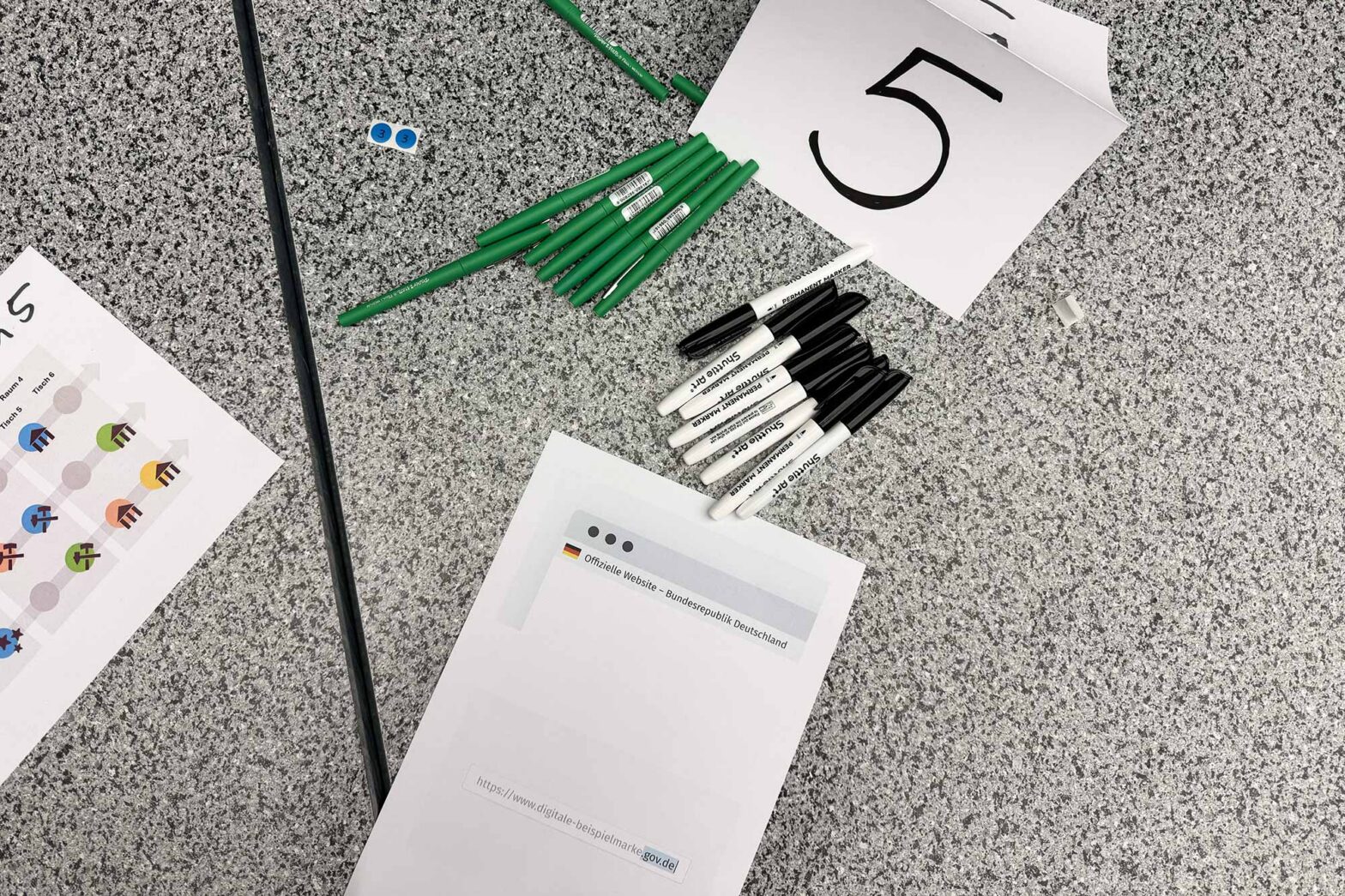
The Federal Press Office invited us to a half-day on-site branding and design workshop. It is rare to gather with 30 design colleagues from all other ministries and departments and have time to compare notes. In a well-facilitated manner, we were split into 4 groups and offered our insights. It is input for a government brand refresh exercise they are launching.
Like everyone else, I brought examples of what’s good or great and what can be improved. I also felt compelled to highlight the parallel work on the cross-government branding and design system. People in my group had just reworked their ministerial website and were unaware of the slim government header, for example. It once again showed the need for better, broader communication.
We left the space after 4 hours, with whiteboards filled with notes. This work will continue over the coming months, with all of us getting involved frequently, we are told. I look forward to seeing where this is all going.
Defining the Deutschland-Stack
On Sunday night, the second consultation round for the D-Stack ended. Somewhat similar and yet different to the Eurostack and the GovStack, the D-Stack is supposed to define how Germany’s public services are structured and technologically composed.
In the last few days before the deadline, quite a few design system-related submissions came together. Multiple state-owned entities proposed their solutions as components of the D-Stack. Some received a moderate number of 2 to 3 responses, but one got some good traction. The KERN Design System, now accessible via designsystem.gov.de, received over 50 responses on OpenCode. Various cities and states described how the KERN Design System helps them offer better service to users.
I added a comment as well, describing what we see at DigitalService. I recapped our activities described in the November blog post about adopting the KERN Design System. Good to know for decision makers is that we were able to use it widely:
- for information offerings – like servicestandard.gov.de
- for transactional services and navigational offerings – like service.justiz.de, which is currently being reworked
- for platforms and portals – like the ‘work and stay agency’ sketch colleagues worked on
- for caseworking systems like the justice communication platform
I am curious to see what’s going to happen next, and now the consultation input will be processed.
Writing a white paper and gathering insights
Sonja and I checked in with NExT network colleagues to get the white paper on digital identity we plan to write cleared from their side.
While we could write the paper independently, it makes much more sense to do it with them as a partner. They can help us bring more people to the fold and then publish it with more oomph later. More importantly, their original NExT workshop format has been a bit dormant. It’s a perfect fit, and I pitched for reviving it. Just days later, by Friday, the NExT board approved our white paper proposal. So, we are good to go with our activities.
Earlier in the week, I met the Fraunhofer research unit Competence Centre for Public IT (ÖFIT). They plan an annual quantitative survey to research trust in digital services and the state. We discussed how we can contribute to and benefit from it.
Tweaking servicestandard.gov.de in substantial ways
We are gaining momentum in improving the home of the Service Standard. Until recently, we have been dependent on external developers due to funding mechanisms and legal structures. They did solid work, and we were able to launch a good servicestandard.gov.de offering last year. As their main focus is on other areas, we couldn’t make the progress on the page we wanted to. That has changed now.
Developer Ronja is supporting the team now in a part-time capacity. And designer Marius, whose project will start with a couple of days’ delay, jumped on the task. One tangible item finished this week is the poster page. I helped take new pictures.
Other improvements included a ‘Skip to content’ link for users navigating with a keyboard, rearranging the navigation on smaller screens, and improving headlines, text and spacing. It’s the many smaller things that we weren’t able to tweak with our previous setup. It feels liberating to have the designer and developer nearby – in the office and on Slack. As it should be. Work moves faster, quality increases. Having a designer on board who is working directly in GitLab is a huge bonus.
What’s next
Hopefully, we’ll be able to open up roles. We are looking for a second content designer for the team working on the Service Standard. In addition, in the ‘starting a business’ work stream, we are seeking a working student for user research ops.
Also, I was delighted to see my friend and colleague Simone open up a service design role at the digital agency of the State of Brandenburg. I think there hasn’t been any time in the past 15 months when I started tracking user-centred roles in the German public sector without an opening somewhere. This is encouraging to see.
Throughout the week, I plan to complete the content design blog post I am co-authoring with my colleague Torsten. Then, I will have to swiftly return to another text on capability building to meet government standards, which I am writing with Anna.
On Saturday, I hope to participate in a citizen workshop as part of the service quality criteria work. It’s 1 of 3 held nationwide. Luckily, I don’t have to travel far, as one of them is taking place in Berlin.