
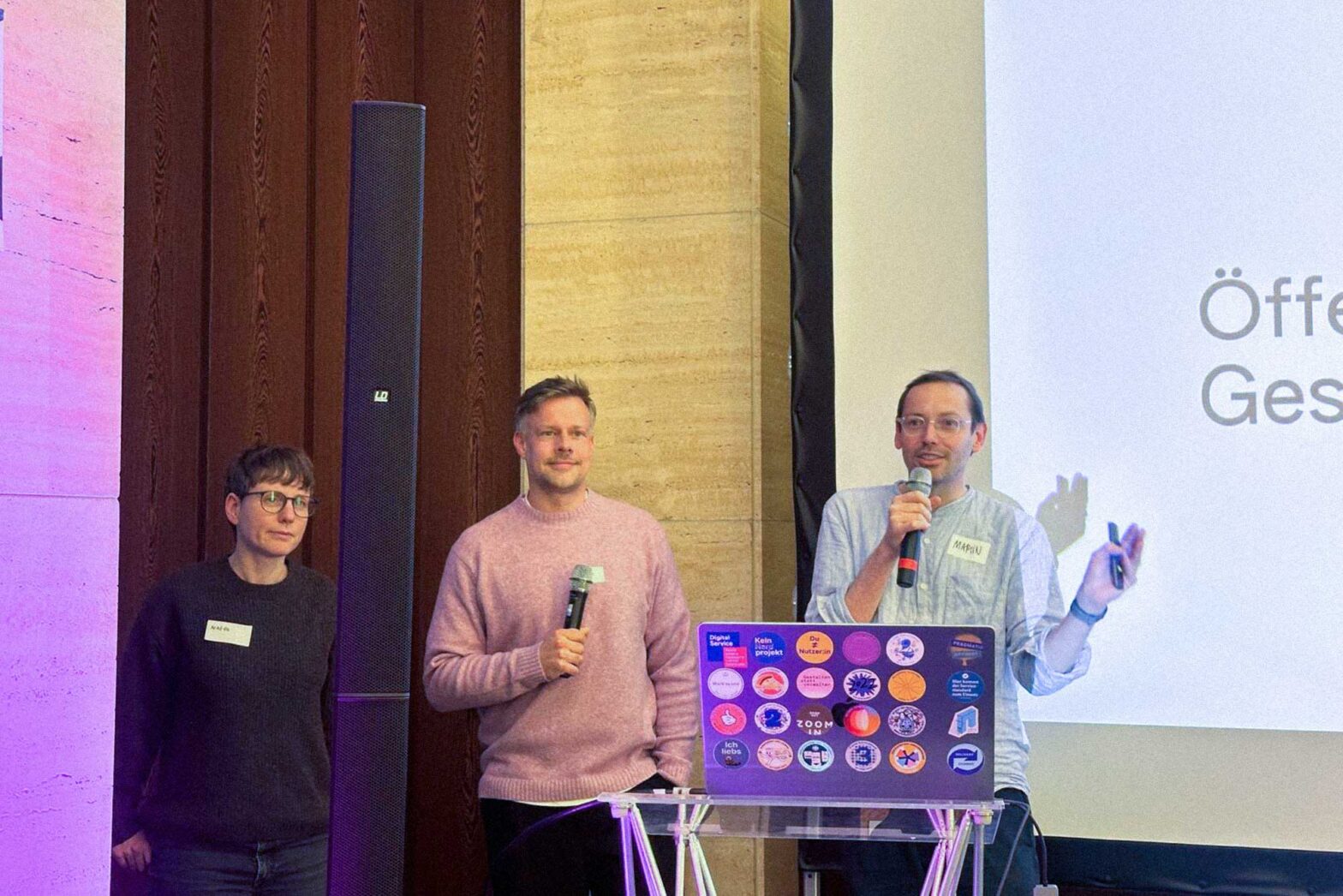
You have no idea how much good work is happening in the public sector. Neither have I. That is why I co-run meetups. They make good things visible and invite exchange.
Government and the wider public sector lack channels to document and share the good work they’re doing. Besides press releases, there is often far too little record of work that thousands of colleagues and the public should know about. Open events allow outsiders to make the work better and let people build upon it.
Government also desperately needs more spaces for interaction and conversation – with public servants and members of the public alike. Often, culture prohibits the spaces from forming. But that is counterproductive; to build trust in the state, we need such forums.
Celebrating 3 years of public-facing meetups
On Thursday, we ran our 12th public-facing event in 3 years. In April 2023, we launched our Berlin-based event format to have our own outlet for discourse. We had been sharing our own work at other local meetups. Yet we wanted to explore public-sector topics and themes in greater depth. Christian, Magdalena and I kicked things off; Tobias and Victoria joined soon after. Eventually, Lisa joined and now Tim. It requires a small crew to run these things.
Much of the format is shaped after London’s Gov Design meetup. I co-founded it in 2017 after moving back there. I was surprised by how much terrific work was happening in the public sector – and how little of it is visible. The same applies to Germany today.
Over 1,000 people are part of our meetup group now. It has a 4.8-star rating out of 5. But people aren’t very loyal, which is ok. They often come for a specific topic that draws their attention. Only about 20% are returning attendees, we found.
I co-run meetups to satisfy my own curiosity. Each of the topics we discussed was to scratch an itch. Favourite past topics included ‘Innovating public healthcare’, ‘Reshaping urban mobility’, ‘ Visualising data’, and ‘Filling the gaps’. Each event taught me something new. It also allows me to design a poster every quarter and hone a neglected skill.
Meetups are also a vital tool for recruitment. They give potential candidates interested in open roles an idea of what it’s like to work for CityLAB Berlin or DigitalService. An evening allows for conversations you might not otherwise have.
‘Remaking the welfare state’ was this round’s topic. We had 4 speakers at the event: Anja Mayr, Björn Mohr, Dr Florian Theißing and Jakob Häußermann. As always, talks were in English. That is obvious for attendees, but not always for the public servants we request as speakers. In an international city like Berlin, public participation requires English.
Around 60 people joined for 2 hours straight without a break. The attendees had plenty of questions, and our speakers shared insights into the improvements people relying on social services would benefit from. They disseminated problems and potential solutions to high-level and detailed issues.
This time, the no-show rate has been close to 40%, which is a new high. At the same time, it was a big event, with more returning attendees than before. The learning for me is: simply opening more seats doesn’t harm.
As always, we recorded the talks. And as always, I will edit them as soon as I can, but it might still take a while. They will come eventually.
Talking about good digital governance
At the invitation of the Deutsche Welle Akademie, I spoke with members of parliament from the Kingdom of Bhutan this week. Deutsche Welle is Germany’s international public broadcaster. It’s German state-funded. Its mission is to facilitate intercultural exchange and promote democratic freedom. Together with the Bhutan Center for Media and Democracy, they ran events under the series ‘Building Inclusive Democracy’. A 2-hour session on Thursday was part of it.
‘Digital governance’ was the main topic. Within the 10 minutes I had, I chose to talk about ‘good’ by involving the people affected. I emphasised the importance of leaving the building as a policymaker and involving people early and frequently. “Don’t let government work in its ivory tower”, a slide said in big letters. I suggested identifying the people affected by the work and including them. I illustrated that practice with 3 examples from our recent work:
- Involving users when designing digital public services
- Involving organisations when developing government standards
- Involving citizens and residents in defining what good services are
It was the first time I spoke about our ways of working on the Service Standard and the service quality criteria combined. It felt like a good fit for the event’s topic. It seems to have resonated with the audience of some 30-odd people who joined.
I wrapped up my little input with 3 suggestions for the attending audience:
- Consider who is affected in the matter you are responsible for
- Review your development process to find ways to open it up
- Make ongoing participation and involvement easy
After answering various questions, the next speaker followed: Annela Kiirats from the Estonian e-Governance Academy. She gave an overview of approaches to engage citizens over the past 25 years. That included an annual opinion festival and a 1% participatory budget at the local government level.
We both answered various questions before I was asked to give a closing statement. I reemphasised my plea to take small steps to include the people affected by the work the attendees are doing, and then make it a habit. I enjoyed the exchange, have put the slides up on GitHub, and hope to build on the content for future talks.
Getting hands-on with designing around life events
Since attending the closing life events workshop in Paris in December, I wanted to work with the received material with my colleagues at Digital Service. On Wednesday, there finally the chance to do so.
Taking over the service design community of practice slot, I ran a session with Carina on designing services around life events. We offered some context for why we are doing it and why now. We were curious to hear how the 8 participants saw life events and their work in relation to them. For that, we also brought implementations from the Netherlands, the United Kingdom and the City of Munich. Furthermore, Carina sketched a 5-stage maturity level, which I illustrated. We also used a 2-by-2 matrix to map our service work along dimensions of complexity and interconnectedness.
Eventually, there wasn’t enough time in our 90-minute session to go deep enough into applying the OECD-provided card deck to our service areas. So, we will return to the topic at the next community gathering in a few weeks from now. With various services linked to people’s life events, I want us to develop more material and our own frameworks, and to contribute to the global discourse. I believe we have useful insights and potential case studies to offer.
What’s next
We will run an internal kick-off for the digital services and state trust survey that the Competence Centre for Public IT (ÖFIT) wants to run with our input. We will meet with colleagues working on related projects on Wednesday to clarify our involvement.
On Monday, I will speak with someone at a publicly owned digital supplier. I met them in a clinic hour for the KERN design system. They are steering redesign work for the ‘register a vehicle’ service and are supposed to align design styles, which I was delighted to hear. Unfortunately, they had not yet heard of the Service Standard, even though their service needs to comply with it. They were interested in learning more, and I am happy to speak with them, of course.
I also hope to finish a good chunk of the blog post on our delivery principles. On Monday, I wrote the first 400 words. With the introduction complete, the 12 principles will each get a paragraph or two, with some context and an example.
Bene and I are also supposed to check in on our blog post about open road maps. But I am only good at writing 1 piece at a time, so I haven’t made any progress on it yet. Lastly, there is also a piece that Anna and I started in January, where she did the heavy lifting. I am returning to it next week so it can be published in April.