
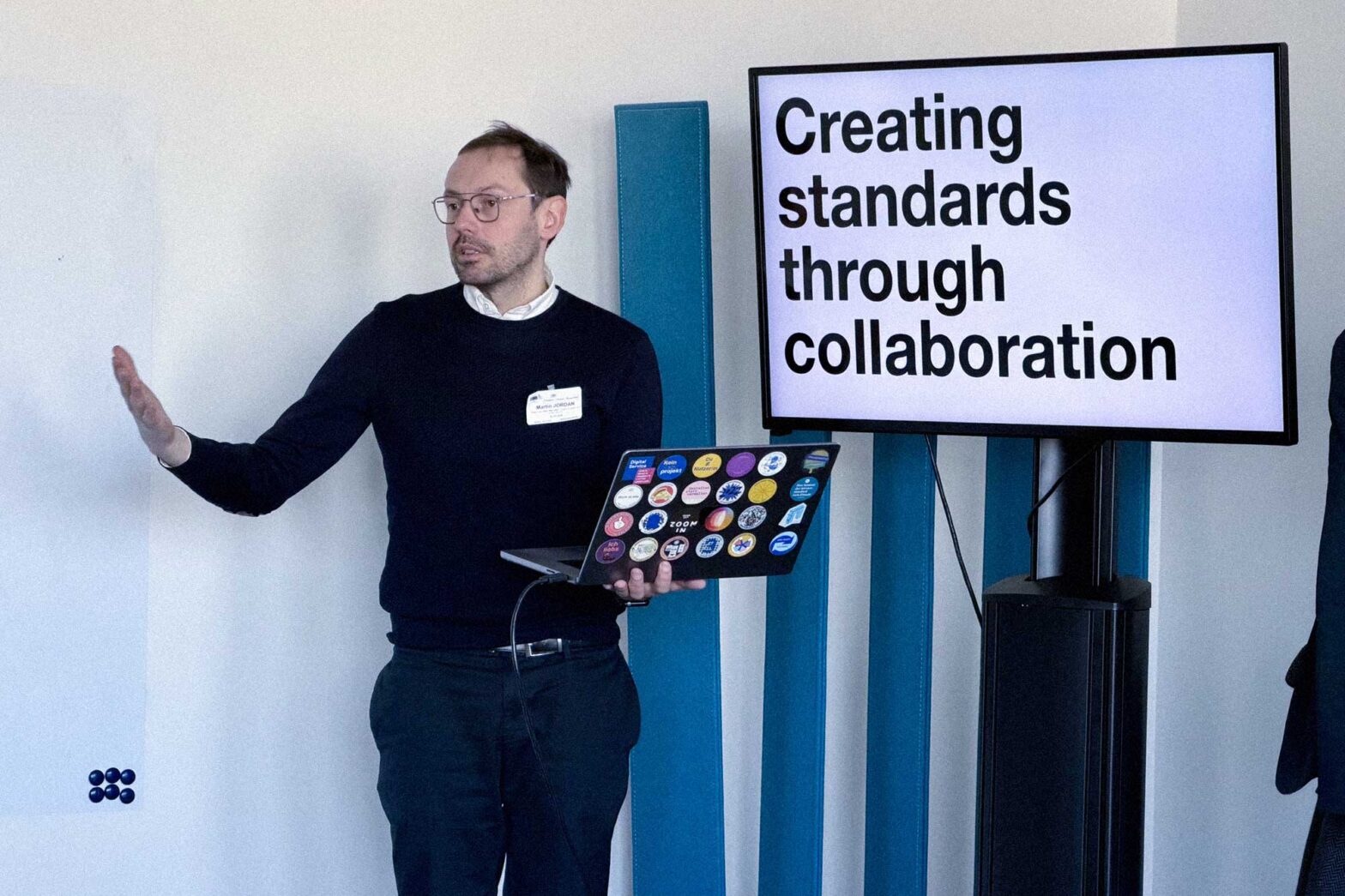
I was given 10 minutes. I kept talking for at least 13.
On Wednesday, I got to share some of our work on ‘implementing change’. That was also the title I picked for the input I gave at the European Commission’s Directorate-General for Digital Services (DIGIT) in Brussels. It was part of an excursion to the Commission’s Digital Innovation Lab – or iLab.
We were a small-ish group of international visitors welcomed to their physical innovation space. The iLab team shared their work of the past few years: resources and training for policymakers to launch innovative initiatives themselves. The EU colleagues were curious to receive feedback on their Innovator’s Playbook, a digital resource packed with methods and artefacts.
Complementary to their overview of work, I was asked to mirror it with ours. My input was well received, and I was immediately asked if I would consider returning for another format. So I might return.
As always, my slides are on GitHub.
Examining future-proof policymaking
Why is policymaking in Germany so stuck in the present? Why can’t we seem to work with longer-term timeframes and think in broader horizons?
I have been wondering this for a while. Seeing talks about the work at the European Commission’s Policy Lab by Ottla Arrigoni and David Martens over the past 2 years further pressed this question. When we co-ran a ‘Design for policy’ event last summer at Digital Service, the contrast between our policy design work and the EU’s couldn’t be greater.
To be clear: I am tremendously impressed by the work my colleagues are doing in policy space. Our multidisciplinary policy design task force team has been supporting various ministries across a broad range of topics during the legal drafting stage. We bring a user-centred, leave-the-building lens to the policy development process; for example, by conducting qualitative research or visualising things that were only ever text-based until then. At the same time, we mostly respond to the government’s very immediate needs and work on issues outlined in ministerial position papers, party manifestos, or coalition agreements. What we haven’t done so far is look at much further timeframes – something I learned at Laurea University during my MBA studies and from the UK Policy Lab.
From Monday to Wednesday, I have had the chance to broaden my perspective on forward-looking policy practice. The EU Policy Lab had invited some 200+ people to Brussels for the first edition of Poly Futures. The event brought together experts from the public, third and private sectors as well as academia. Most of them had either a background in behavioural science, foresight or design. They all shared an interest in better policymaking.
The new format invited to “explore how participatory, creative, future-oriented and actionable approaches can inspire better policymaking”. And it so delivered on that promise! There were 5 keynotes, 24 workshops and experience sessions, a panel discussion and various excursions to Directorate-Generals. It was an event crafted with so much care and dedication that you could sense the organisers’ intrinsic motivations. They curated the event content around 4 themes: trusting, sensing, experimenting, and daring. In hands-on sessions, indoor and outdoor, they came to life.
In the first breakout session I picked, UNESCO colleagues Christine Kavazanjian and Clare Stark looked at the futures of trust. What AI-powered conversations with the future can look and feel like was demonstrated by EU Policy Lab members Marta Malesinska and Erica Bol, who literally let us call people in the year 2040. Chelsea Mauldin and Isabelle Bradberry from Public Policy Lab offered us tools for dual-timeframe policy innovations. They suggested looking at the “neglected middle child of future horizons” – 5 to 12 years. There was much food for thought. I will need time to digest.
Via our International Design in Government community work, Kara and I were asked to support the event’s extension on day 3. We ran a collective reflection session that helped us sort out our minds.
All of this comes at the right time. We are in a vital sensemaking phase. My colleague Anna and I just put out our thoughts on scaling digital transformation. Currently, Bene and I are working on an article about service designers’ impact on policy design for Service Design Network’s Touchpoint journal. So I am interested in any further exchange!
Revisiting jobs-to-be-done
It’s been a while. Back at Nokia in 2013, I worked a lot with the jobs-to-be-done approach. I later applied it at the Government Digital Service when we designed GOV.UK Registers as a service in 2016. User researcher Ellen used it to map high-level jobs in the context of life events related to justice services in 2024. While the hype is long gone, it remains useful in our work.
In 2014, I co-launched the Berlin JTBD meetup. It’s been running for a good decade, but has been a little dormant in the past couple of years. On Thursday evening, my former co-organiser Andrej and my friend Jan revived it for a reunion anniversary edition. We met at Miro’s Berlin office with tahini pizza and alcohol-free beer. A nerdy bingo card broke the ice. I was then one of the people sharing their most unusual stories: on the role of accessibility in nuclear submarines in the UK Ministry of Defence.
The guest speakers, Beat and Yann, shared their work with jobs-to-be-done and their own customer-focused innovation framework. They brought tangible examples from the private sector and quantitative approaches that are applicable across industries.
After bringing back some memories, I want to have another conversation with our researchers on how we can utilise aspects in our daily work. This nicely overlaps with a conversation at the end of the meetup with Elias, a current Work4Germany fellow at the digital ministry. He is looking into the measurement of the service quality criteria we are just finishing.
Writing more
Throughout the week, I finished a 826-word opinion piece on AI and government. I titled it ‘A tool to refine, not a magical solution to fall for’. Charles Landry, the initiator and founder of the Creative Bureaucracy Festival, asked me for a provocative piece. I tried. I think it’s rather thoughtful and straightforward, but I hope it leads to some discussion. It should be published in early June.
Marion and I sat down 2 years after our blog post on accessibility to outline a follow-up. We ended up with quite a list. I will start writing it in early May so that we can publish it in time for Global Accessibility Awareness Day on 21 May.
Clara and I checked in our blog post on our delivery principles. Only a few paragraphs and examples are missing. I aim to finish it in the coming week.
Lastly, I spent time on our service design and policymaking article for the Touchpoint journal. Bene and I are putting together a 1,400-word piece. While the deadline is today, I asked for a few more days to finish it.
What’s next
On Monday, I will record a podcast on accessibility over lunch.
Otherwise, I will be busy with salary cycle feedback.