
We launched new things!
We published a new resource!
We blogged about our progress in accessibility!
Celebrating Global Accessibility Awareness Day
Usability is accessibility. Accessibility is usability. One isn’t there without the other. And yet, even the public sector seemingly treats it as an afterthought, an annoyance, or a legal risk all too often – despite its head start on the private sector in legal and cultural terms.
This week, we celebrated Global Accessibility Awareness Day or GAAD for short. It was another reminder of how far we’ve come, and how far we still have to go.
Over 80 people from all levels of government joined us for an interactive morning event – and most stayed for over 3 hours. Organised by the cross-government NExT e. V. network, we collaborated with the ITZBun to make things tangible. We started with a black screen and the screen reader running. It’s still an experience many public servants haven’t had. It was informative.
Alfred Kranstedt, the Director-General of ITZBund, the Federal Information Technology Centre, chaired the event and gave the caring opening remarks. His colleagues Daniel and Marc ran a practical introduction to accessibility testing. Later, participants rated the session highly.
In her keynote, Professor Dr Erdmuthe Meyer zu Bexten highlighted that we have even regressed on some accessibility success criteria over the last 5 years. It’s mirroring the reporting from BFIT-Bund. They previously found that 0 out of 7,239 tested public sector met all WCAG criteria.
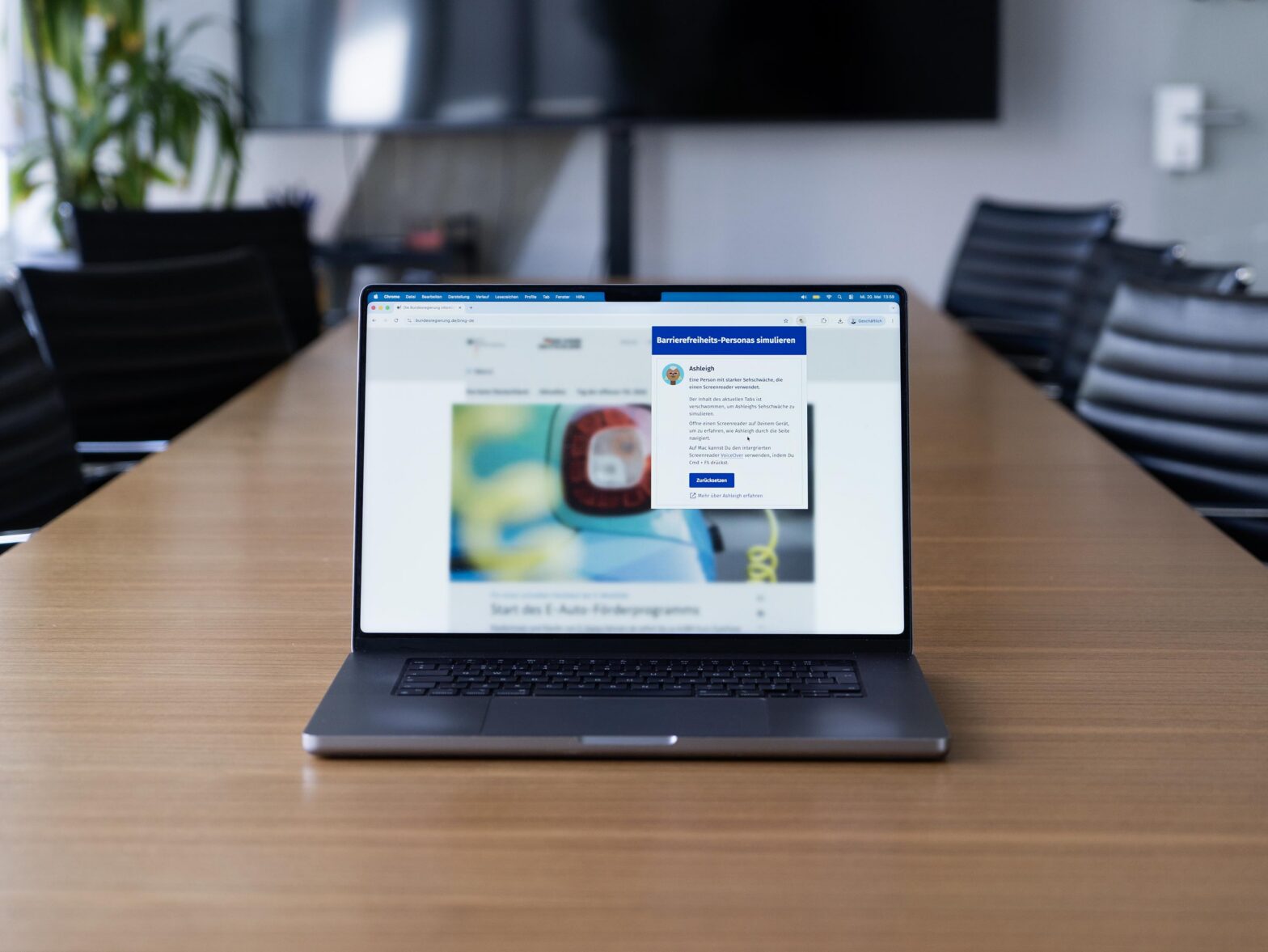
Over 700 people are now using our browser extension ‘Simulating accessibility personas‘. It runs on Chrome, Edge, Brave and other Chromium browsers. It makes the GOV.UK Accessibility Personas easier to set up and use. We just added French and German as additional languages. We also translated the persona profiles and launched them on a new website.
As part of the 3-hour GAAD session, my colleagues Marion and Joshua ran a cross-government workshop on the personas and extension, and answered related questions. People were eager to try to learn.
But just days earlier, though, a German ministry partnered with a federal agency to launch a website that illustrates how terrible things can be. Still, in 2026, in the week colleagues around them celebrate accessibility. It felt like mocking our collective efforts, leaving me in shock. The main interface elements have the lowest colour contrast I’ve seen in quite a while, structural HTML elements are used incorrectly, and the website fails keyboard users. I check daily to see if things improve. They haven’t yet. An accessibility statement is still missing, too.
Evidently, there is much to do and more to learn. Marion and I wrote a new blog post about how we progress and how we set up structures at Digital Service. In there, we share how we’re working on new tools to make government services easier to understand. Plain language is often an under-considered aspect of accessibility. So, we will double down on that and continue internal efforts, and then share openly.
Growing user research
From 0 to 8 in just over 2.5 years. And now, we are looking for 3 more user researchers as our sub-discipline continues to grow. User research remains in great demand at DigitalService – and also the wider public sector.
We are looking for 2 regular-level and 1 senior-level user researchers to join us. Our work is diverse. It includes operational and strategic responsibilities. User research is vital in discovery work, where we aim to understand the actual problem in a certain domain. User research informs early product as well as policy work, helping us understand what to work on next. It allows us to reframe challenges and tasks we are working on in partnership with federal ministries. In the policy space, it has been informing high-level strategic gap analysis work.
User research is no longer optional when building products and services in the public sector. At the request of the German parliament, with the agreement of all 16 states and by the signature of Minister Wildberger, we have a legal foundation that mandates user research across product and service life cycles. The Service Standard, as set out in DIN SPEC 66336 and standard regulation, requires that we involve citizens and residents in our work, research, document, and prioritise their needs. For that and for our ongoing test-and-learn approach, we need more hands on board.
The special and powerful thing about our work is that we are part of something much bigger. We make government work better for its people. “Accessible and user-friendly for everyone”, as it’s described in the coalition agreement. To achieve this colossal goal, we are working across organisational boundaries and sharing our learnings with the wider public sector. Every month, people from 18 public sector organisations get together to share notes on user research. Recently, we started co-producing the first joint report. Because we are learning much in our service areas spanning justice, parental benefits, and starting a business, which is relevant elsewhere, too.
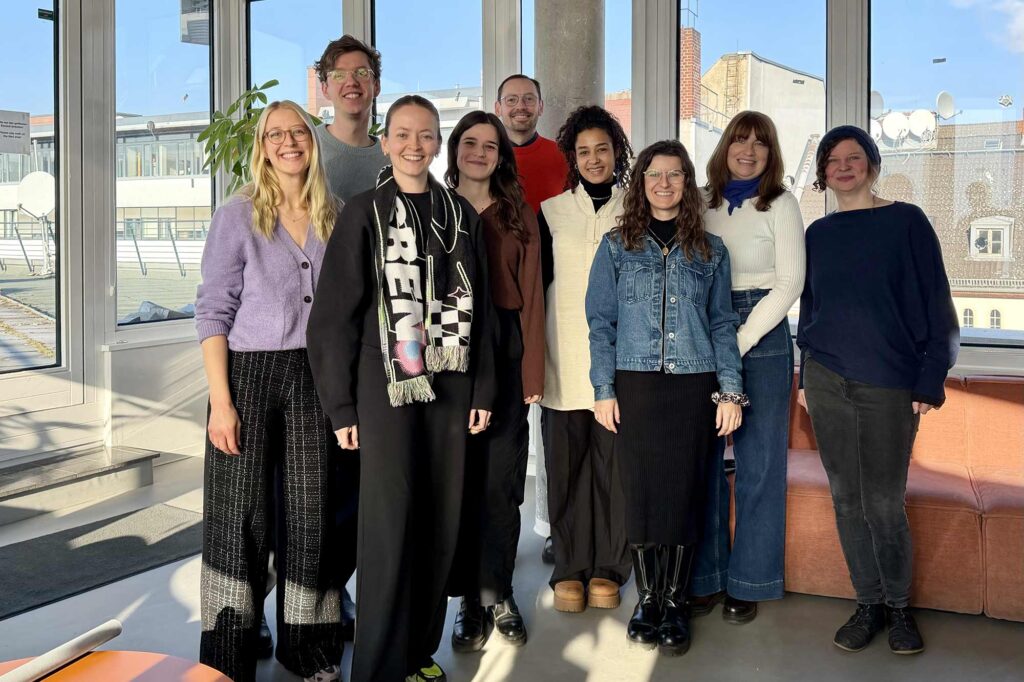
This picture is from late-January. My colleague Sonja Wilczek, who has done a terrific job of building the sub-discipline on robust foundations, organised a half-day user research onsite session. We used the hours to discuss the evolving roles of user researchers on teams. We also identified further topics for 2026. Those include working at scale, transforming project data into theme-based knowledge to inform life events work, and amplifying the users’ voice.
There is plenty of meaningful work ahead of us. People can now learn more about our work and approaches through podcasts, videos, and blog posts. We have more material than ever to inform applicants about our work, way of working and working culture.
With 50 people in our discipline soon to be 50, we are the largest design and user research team in the German public sector. We are hoping for strong applications. We understand that our requirement for C1 proficiency in English and German is a barrier.
Talking about design differences
95% of the people we hire come from the private sector. But things aren’t the same, so I wrote a talk about 10 things that are different in the public sector.
10 years after my first public-sector design talk at UXcamp Europe in 2016, I decided to give a broader overview of how our work differs from that in the private sector. With over 600 participants, it’s one of the largest barcamps for design and user experience professionals worldwide.
It’s also the most open and welcoming format for pitching a topic, gauging interest, and presenting it. I joined it on its second day on Sunday.
Embracing the spontaneous bar camp spirit, I set the alarm for 6:25 am on Sunday to write the talk, pitch it at 10 am, and deliver it at 2 pm.
I titled it: ‘A different kind: design in the public sector’.
Here are the 10 differences I described and evidenced with fresh examples from our work at DigitalService:
- For the greater good
- Inclusive, not exclusive
- Serious about accessibility
- The underlying rulebook: rewritten
- Collaboration across organisational borders
- Design where decisions are made
- Design with systemic complexity, always
- Opening up
- Copycats encouraged
- Growing design capability
As we continue to look for people for open roles in user research and content design (see point 10), it’s helpful to set the scene and clarify where things diverge. After the talk, I had several conversations with interested participants. I also spoke with a former applicant, who welcomed some encouragement to reapply.
What’s next
Next week, I need to return to our 95% finished blog post on delivery principles. At the latest, I want to see it published in early June.
We plan to trial a new format with Head of Product, Clara, and Head of Engineering, Niko, on Wednesday morning. It’s called ‘product review’, and we will do exactly that: review things in development that are supposed to go live soon-ish. The first thing to review is the website for ‘Digitale Dachmarke’, the new home for the cross-government brand and design system.
Furthermore, I will work with transformation manager Fabian on bringing the Service Standard peer reviews back on track. Since updating it to version 2, we have only run a single review. Now, we are aiming to do another 3 reviews before mid-autumn.
Lastly, I will support Sonja’s work on our paper on digital identity.