
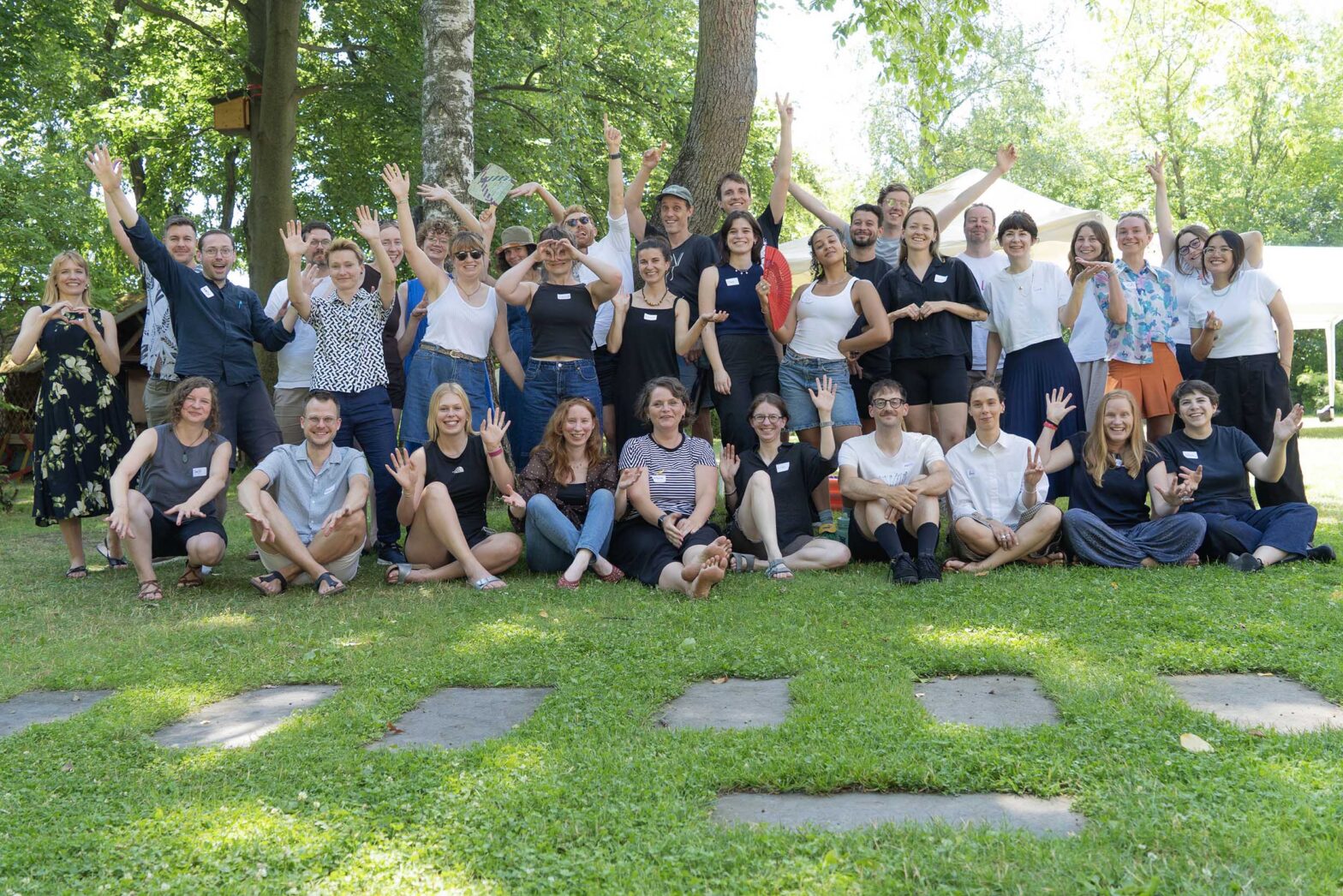
50 is the number I’ve been somewhat afraid of. We are days away from getting there. Next week, we’ll have the 50th team member join our user-centred design discipline at Digital Service.
We are the biggest user-centred design team in the German public sector. This fills me with equal pride and respect. At this size, we can make a bigger difference in improving people’s experience with government. At the same time, being 50 means we will have less time to interact with each other individually. Things are different from just over 4 years ago when the team consisted of 8 designers. I have to acknowledge that my time is finite, and with more managerial layers, we can sometimes feel removed from each other.
The larger our discipline is, the less likely we are to maintain deeper, more meaningful connections among ourselves. That is why principals Charlotte and Sonja Wilczek and I, with support from people partner Annemie, work to develop the discipline’s structures and formats to suit its size.
Our discipline represents 19% of the 260-ish people at DigitalService. This ratio has been fairly consistent over time. We see that our disciplines grow in equal proportions. So we learn shoulder to shoulder with engineering, product and transformation management.
Today, we are 3 communication designers, 3 content designers, 1 legal designer, 7 service designers, 10 user researchers, and 24 UX/UI designers. We specialised quite a bit in the past few years, which is worth another blog post we are currently writing. These 6 specialisations are useful labels for differentiating skill sets. But we also don’t neatly fit into boxes or skill frameworks. We have broad knowledge, and we need to take time for exchange.
Running our annual summer offsite
On Thursday, at 34 degrees Celsius, our user-centred design discipline got together, as we do every six months. Marion welcomed us at the offsite location with a moment of mindfulness. Then, throughout the morning, we discussed individual career and growth paths – from focusing more on delivery to specialist expertise or contributions to the discipline.
At lunchtime, we discussed digital inclusion, as it’s on our minds. Kara Kane joined us remotely to share the remarkable trauma-informed inclusive design work she is doing at the Cabinet Office with local councils across the UK. She emphasised that inclusive design needs systems thinking. We had many questions. Afterwards, various team members shared their approaches to inclusive user research, content and design. We continued workshopping in the summer heat and collectively appreciated the thoughtful time we spent together.
While my time with colleagues is stretched thinner, I try to maintain a balance. There is work on the organisation and work on the discipline. At the same time, I try to stay as closely connected to the service transformation across our domain areas as I can. Being close to the work means being close to the people. That’s where I like to be – as we grow further.
Running offsites regularly and taking the time to get to know each other, comparing notes, and making sense of where we are and where we are going is utterly important. We need that to feel like a discipline and community.
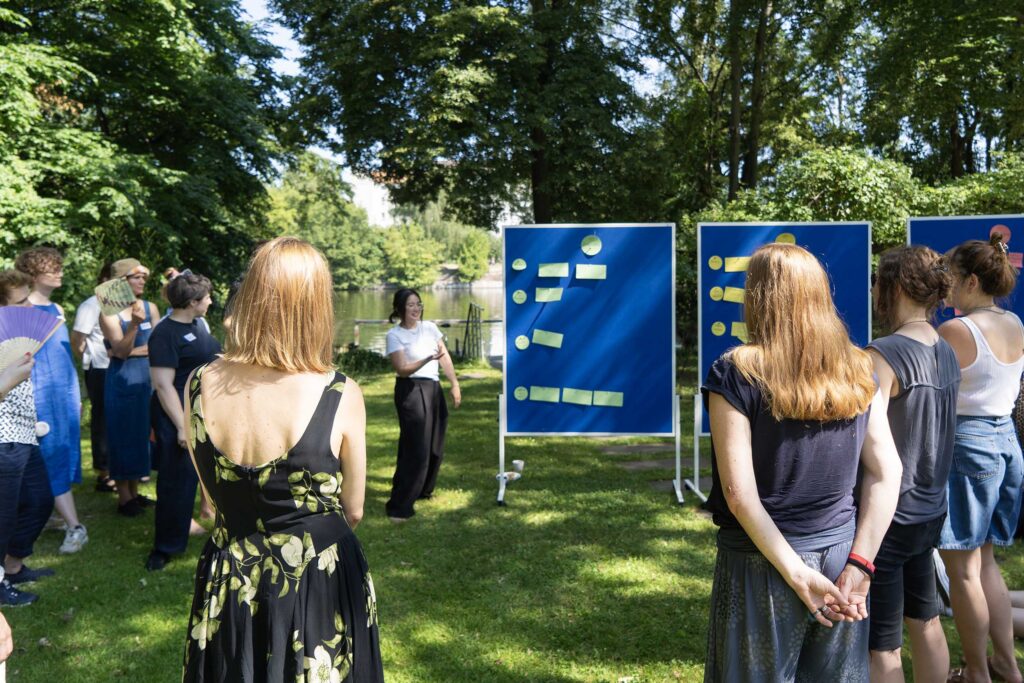
In my little opening reflection, I talked about the impact we see when we zoom out a bit further. Of course, I referenced some of the thinking from the long slog, including its time horizons. I also referenced our delivery principles and the 10 differences in doing design in the public sector.
Looking at our work from multiple angles and layers of abstraction, I invited everyone to review our ongoing work along 2 dimensions: local versus systemic and now versus future. For illustration, I mapped our work on design patterns and the parental benefits calculator. I also plotted different aspects of the Service Standard work as well as our policy design work with lawmakers.
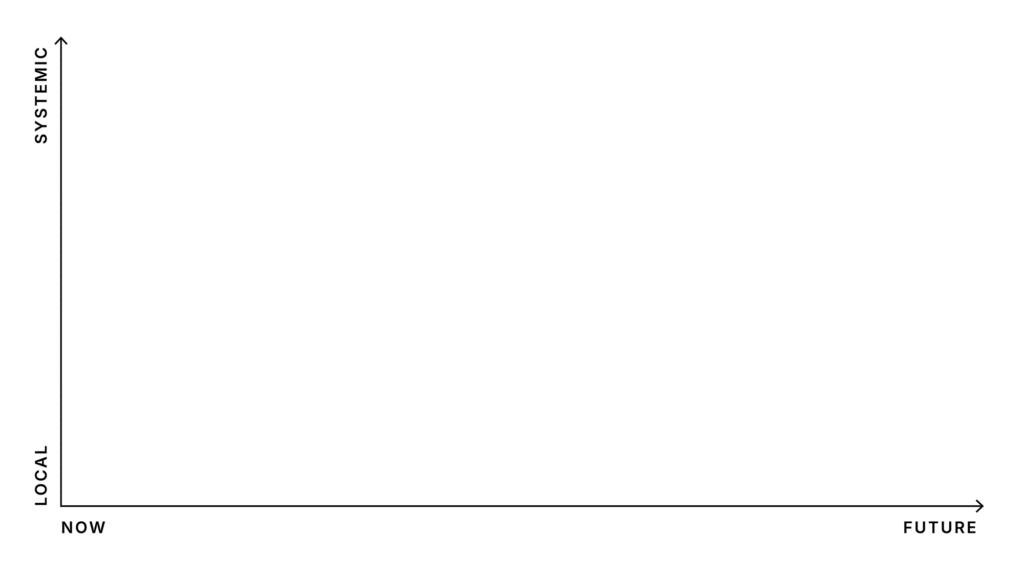
There is some work we do halfway between now and the far-out future, and some we do higher up on the systemic dimension. But nothing scores highly on the systemic and future fronts. The question is: Should there be? Or is it fine to leave this to others? That is something to discuss in further weekly sessions with the discipline – and possibly in another lunch-and-learn session over the summer.
Still hiring
On Monday evening, I stopped by the Service Design Drinks Berlin meetup. Conveniently, it was just around the corner from home this time. I used the dedicated community time to highlight our open roles.
You don’t get slides for the community corner. You only have a microphone. So, thought I should bring a printout of a QR code that leads people to our page with open roles. That worked pretty well. People pulled out their phones to see what we got. And I had various conversations with people following up with me after the main act, a panel discussion on ‘Changing economy, changing design roles’.
Throughout this week, I continued interviewing more candidates – for both content design and user researcher. That is going to continue.
While welcoming this month’s newbies, I also co-ran another accessibility onboarding session with engineer Chris.
Experiencing community work in action
More than 4 years of building cross-government relationships pays off.
User researcher Joshua attended the monthly cross-government user research exchange to share the current version of his feedback guidance and to gather feedback on the draft. We already had an in-person feedback session in late March with a colleague from Munich. Now, 5 public sector organisations were present and kindly provided their feedback.
We must test authoritative guidance early and regularly. Otherwise, it won’t be good. If it’s not good, it cannot serve many in many circumstances. If it cannot consider many contexts, it cannot be authoritative. It’s something we stated in 2020 when we picked up work on the UK Service Standard. And it’s something we’re now practising for our work on the German Service Standard handbook guidance.
I am glad we have established these formats. They have moved from discussing the basics to using these sessions for co-creation. Reviewing content is one step; co-writing a paper is the next. I am impressed by the work that a dozen public sector organisations have been doing in recent weeks and months. The paper on ‘digital identity in use’ is coming together through a collaborative workshop mode. I spent some of my time on Thursday reviewing the draft for consistency and correctness. There is still a bit of work ahead of the publication next week.
What’s next
On Tuesday, I plan to participate in a follow-up on the brand design refresh for the Federal government at the Federal Presse Office. It’s the second progress check-in for colleagues they have been inviting us to. The last one was in April. I am curious to see what they are working on.
The cross-government working group will present the paper on ‘digital identity in use’ with an event on Wednesday morning.