
We started actively working on our talks more than 1 month before we had to give them the first time. That is pretty good. I am impressed.
Preparing our policy design talks for autumn
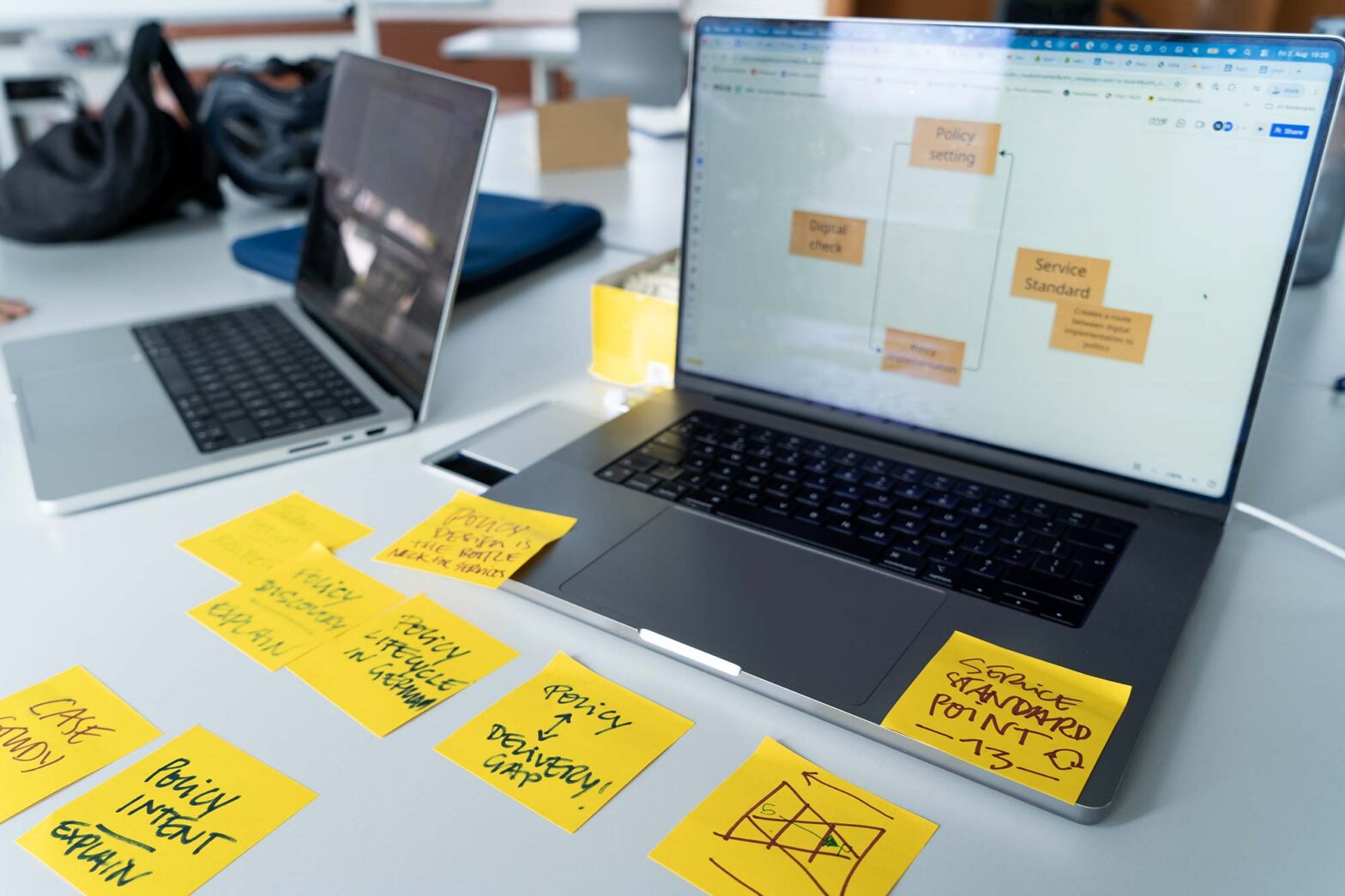
Nina and I spent Friday afternoon rereading our proposal, reviewing our suggested timings for the talk, and sorting suitable material.
We have the first talk on 23 September 2026 at the Service Design in Government conference in Edinburgh. It will be titled ‘Policy and service design as one – how Germany skips the silos’. Then, on 30 October 2026, we will be speaking at the Service Design Global Conference 2026 in Wiesbaden, close to Frankfurt/Main, about Upstream impact: How service designers shape better policies’. There will be sections that will be similar; others will be different.
We sketched out the rough narrative, divided our sections and set up a slide deck. I also started digging into more models and frameworks that we can build on in the talk. One of the models we looked at is from the 2013 ‘Design for public good’ report that the Design Council produced with the support of the European Commission.
I find it useful to review older models that were possibly ahead of their time and see how reality began to catch up to them. We still have quite a bit of work ahead of us, and we will continue preparing the talks in the coming days.
Dedicating time to look at life events
This week, we had a new senior service designer starting, Lea. Starting on the bench and not yet having a running project allows us to look into things that don’t have a direct project link.
One thing I want us to do more of is directly working on life events as a service design anchor. We have done that here and there, but it has not yet manifested in better service navigation, information offerings or broader service redesigns. And it always has been something of a side activity. Now we have the chance to make a greater effort and investment. We see activities and progress in all levels of government – supranational, national and local. The OECD continues to run webinars, countries like the Netherlands develop good patterns, and so do cities like Munich. I want us to collect and consolidate the good things that others already do. That should provide us with springboards for our activities in service areas such as justice, work, and social welfare.
We will work on this over the coming days and weeks, and I expect us to turn this into an international call on the topic as well.
Workshopping civic ledgers, service accessibility and a quarterly roadmap
I was a little fragmented again this week.
On Monday and Tuesday mornings, I attended an external workshop on civic ledgers. It explored how dynamic permission management can happen in a local context. It was hosted at Dark Matter Labs Berlin and Politics for Tomorrow. Some smart people whose thinking and writing I admire participated, including Indy Johar. Conversations moved from legal to cultural to technical to philosophical, changing with the different people in the room. I missed the later parts of the workshop and its conclusion. I hope to hear more about the work in the coming months.
On Friday morning, Marion and I teamed up for a manual accessibility testing session for the ‘starting a business’ service that’s in the making. It was a great learning opportunity. I am familiar with some things, such as testing for high-contrast mode, keyboard use, or structural testing. I am less familiar with testing error behaviours with a screen reader. I have also followed different approaches for testing with magnification before. We saw some robust practice, but we also found a few issues, which we documented for the team, which is currently very busy, and appreciated the hands-on support.
With the Service Standard team, I participated in Q4 roadmap planning. We discussed epics presented by different team members and answered open questions. We skipped any sizing, rescoping and prioritisation tasks. I also made some progress with my naming guidance for the handbook.
Sharing how we do user research operations
We don’t do customer testimonial stories. But people are curious about how we conduct user research – both inside and outside government. So, we followed an invitation to capture our current practice.
In a story on the Condens website, my colleagues Ellen and Leonie share what we do. They explain how we gain insight into people’s needs and struggles, how we conduct analysis, and how we share the learnings with stakeholders – using their tool.
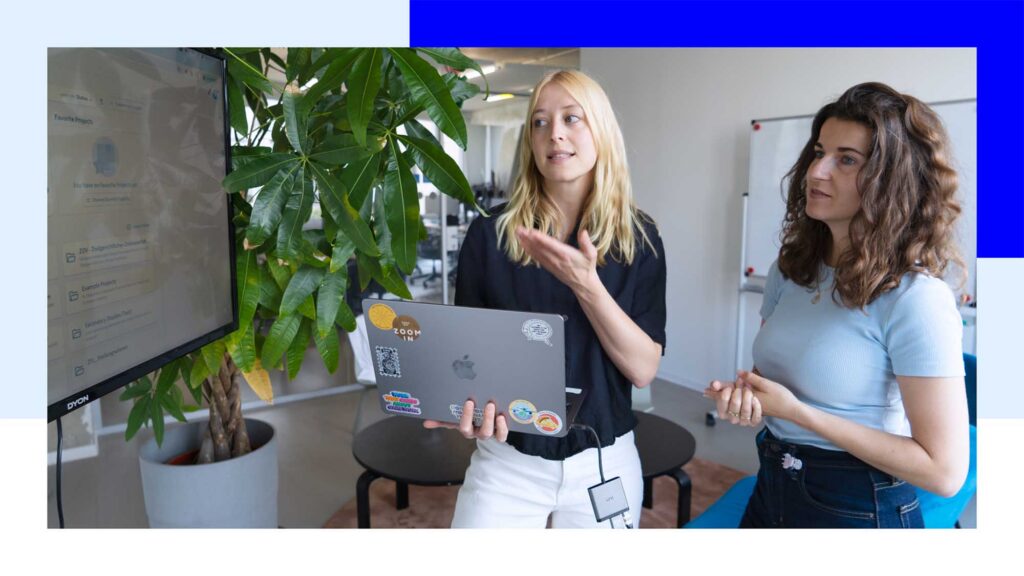
When a minister gets to see a 90-second summary cut from the most recent interview round or usability test, we use our research repository platform of choice.
As a non-ministerial unit of the Federal government, we have more liberties regarding the tools we use. At the same time, we have to make sure they are GDPR-compliant, that the data is stored on European servers, and that we have a strong data deletion regime in place. With that in mind, my colleague Sonja screened several user research repository tools 2 summers ago. Various US solutions that private-sector organisations often use weren’t feasible for us. Still, we wanted to have a modern tech setup that is future-oriented and allows us to benefit from productivity gains through integrated AI tooling. That is how we picked a small bootstrapped German option.
At Digital Service, every team is set up slightly differently and operates somewhat differently. Yet we want – and need – to document the work consistently and be able to learn across different workstreams. That is why harmonising documentation across a growing number of projects is important. It’s essential operational work, and it isn’t optional if you want to scale further. It also helps your stakeholders grow further trust in your work.
One of the unit heads in the Federal Ministry of Justice wrote to us after spending time with a so-called insights magazine. As a major project partner, he was curious and excited about the data and about how he could access it.
Actual research is the smaller portion of the work. Communicating the work and landing the insights always need plenty of space on a researcher’s calendar. Having a tool that natively helps you with it is powerful and makes the work more effective.
“I don’t think you become a researcher and be a good researcher if you want to be the most popular person in the organisation,” Leisa Reichelt recently said in a conversation with Gerry Scullion. While listening to their podcast, I wondered what the attitude towards user researchers is in our organisation. I believe they are quite well respected. They are great humans, but they are also supported through structures and tools we continuously improve. And their popularity has much to do with our values and culture. ‘Dare to learn’ and ‘Care to challenge’ aren’t just phrases on our laptops. These are things we practice and live in our daily work. Hence, our user researchers are seen as colleagues who can help teams achieve that.
4 more user researchers are starting at Digital Service in September. I’m hopeful they will be popular, too.
What’s next
I will have to finish the first version of my guidance draft on naming services. On Wednesday, I am supposed to present in the Service Standard’s bi-weekly ‘share & feedback’ format.
I also need to finish a personal leaving gift for user researcher Joshua. He is leaving us shortly and will have his farewell next week. I have something nice in mind, which I will still have to design.
Later in the week, I will also speak to 2 different colleagues at AKDB, a public sector organisation belonging to the State of Bavaria. We will discuss a workshop and the progress on improving digital identity in Germany.