
Digital Service as an organisation got seriously big. We are over 260 people now. That is more than the United States Digital Service (USDS) was at its peak.
With many new people from wide-ranging backgrounds joining the organisation in the past few months, we have seen a strong need to tell people who we are and what we do. So, we used a lunch-and-learn slot on Thursday to talk about our grown discipline.
Reintroducing the user-centred design discipline
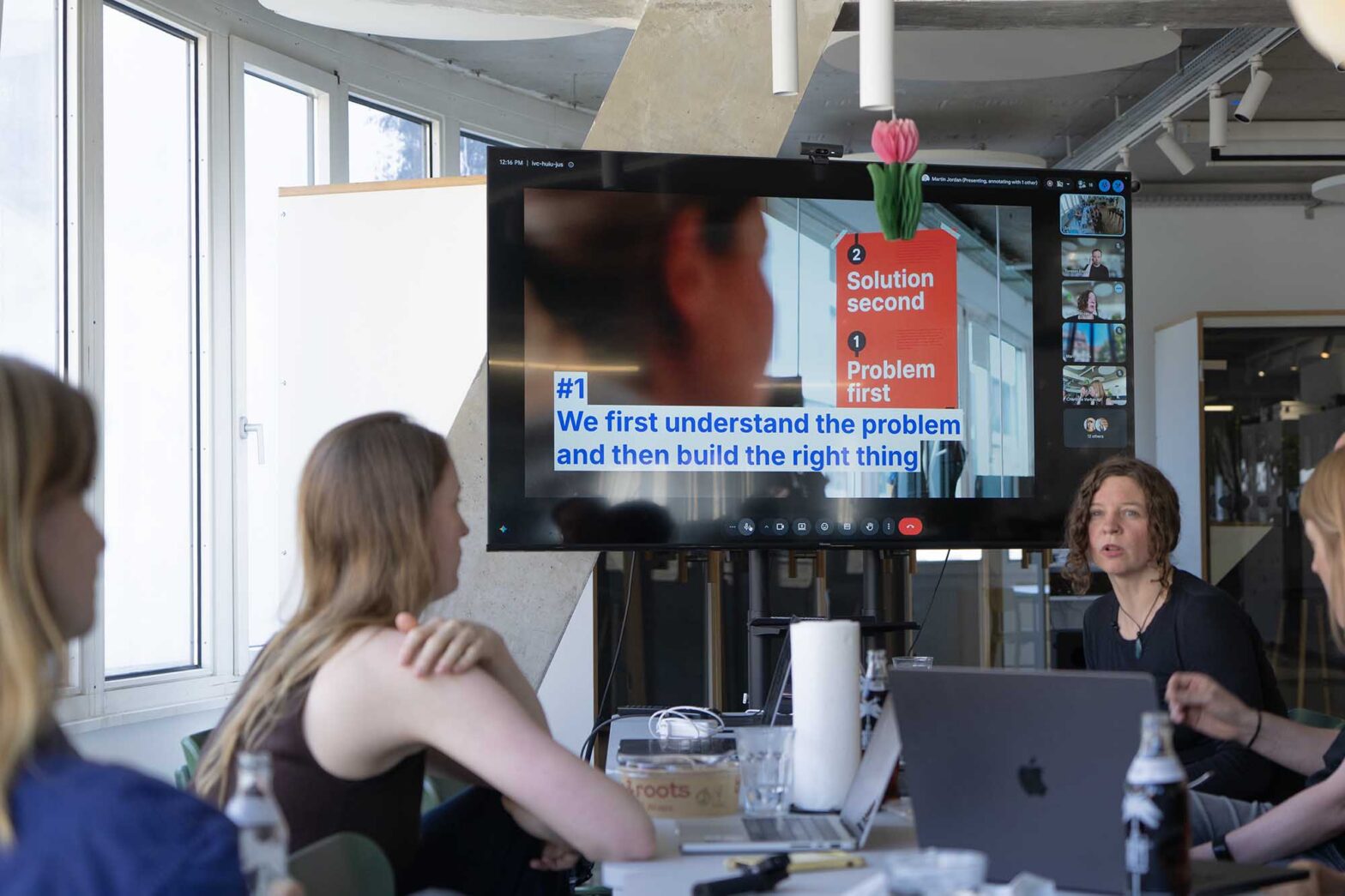
Charlotte, Daphne, Sonja, Torsten and I sat down in the 3rd-floor kitchen space on Thursday. A smallish group of people joined us, both in person and online, to hear an update on our progress. Each of us represented a different sub-discipline. Charlotte covered UX and user interface design. Daphne talked about communications design. Sonja represented user research, and Torsten described what content design is doing. I started by giving some context and describing our trajectory so far.
At the start of the session, I acknowledged that, as a discipline, we are a little different. We aren’t just one. But at the same time, we are. No other discipline has this kind of sub-disciplines established. That sets us apart. So, we are a single discipline with diverse areas of expertise in user-centred design. We wanted to acknowledge this and invite interested colleagues for an exchange.
At the moment, our discipline represents 19% of the entire organisation. Most designers and researchers work in our ‘access to justice’ project: 11 people at the moment. The second largest team that is well-staffed by our discipline is our work on the ‘starting a business’ service – 8 people. In the policy design space, we have another 7 UX and service designers.
We re-shared our discipline’s value proposition, which is also part of the onboarding to the organisation: “We make insights tangible and design valuable solutions that work well for all users.” We also shared 5 points all user-centred sub-disciplines have in common:
- We first understand the problem and then build the right thing
- We work user-centred and prioritise evidence over assumptions
- We think holistically and make complexity tangible
- We collaborate to drive organisational transformation
- We prioritise accessibility and inclusivity to support all people
Then we took turns sharing the 3 things that are most specific to each sub-discipline.
With all content prepared, we will work on turning this into a blog post about our discipline’s growth over the past 5 and a half years. We wanted to do that for a while already. Now the narrative is there; we just have to write it up and publish it. That is my task for the summer.
Making work personal – and experiencing the need for building trust
Work got personal recently – affecting my family more than I had considered. And our team’s work could have prevented the harm.
My mother needed an official extract from the land registry. Searching for the service online, she ended up on a website listing various services in plain language. She thought it was the website of the German government. But it wasn’t. It belonged to a Dutch company. My mother only realised the scam a few days later when she was charged twice on her credit card – 5 times the amount her municipality would actually charge her for the deed.
My mother is no noob. She has been using the internet for 30 years. But things have evolved. Fake websites, scams, phishing and fraud have become more sophisticated, especially in the AI era. Many businesses fight impersonation, and so must governments. It needs to make an even greater effort to secure its digital channels and ensure people find trustworthy signifiers.
A couple of weeks ago, we launched dachmarke.gov.de for that reason. It’s the Federal Ministry for Digital Transformation and Government Modernisation’s new offering for public servants to learn about the 4 trust markers and how they work together: header, symbols and word mark, domain name, and design system.
Over the past couple of years, collectively, we have had the chance to build a few powerful interlinked resources:
Now, we are working with the Competence Centre for Public (ÖFIT) to underpin this work with qualitative data. We are supporting a study on ‘trust by design’. I appreciate the inquisitive exchange with Maximilian Kupi, Nassrin Hajinejad, and Daniela Hensel in this effort and look forward to what we will discover.
In developing dachmarke.gov.de, we built on the work of others who came before us, namely GOV.UK and the Cybersecurity and Infrastructure Security Agency. What we do in Germany is rather a laggard move. But it also means we can follow tried-and-tested paths others have taken, reuse what works, and skip what didn’t. Their open work allows us to avoid reinventing the wheel. But that also goes both ways:
After my colleagues Anne and Lena blogged about the ongoing work, Norwegian colleagues from the Norwegian Digitalisation Agency (Digdir) reached out. We recently had an exchange that left us with plenty of new notes.
We are also working together with the Federal Press Office. In another working session with Kathrin and Monika this week, we reviewed an improved decision tree to advise public servants to use the right brand and design system.
By now, some 60 gov.de domains have been registered. The demand is significant. Our team continues to create practical guidance on topics such as choosing a domain name. All domain applications go through a thorough vetting process.
My mother would have needed that: a way to verify that the service she is using is government-run and trustworthy. The new trust markers would have helped her tremendously. Eventually, my mother got her deed. It was not entirely fraudulent. The Dutch company rendered a service to her. Just at 5 times the cost, but highly discoverable and in plain language.
What’s next
I will be on annual leave. I don’t plan to work.
As my copy of ‘Bad Services’ has arrived, it’s something in my luggage.